Prop 40 is dividing CA labor unions and experts argue the fight goes well beyond a billionaire tax


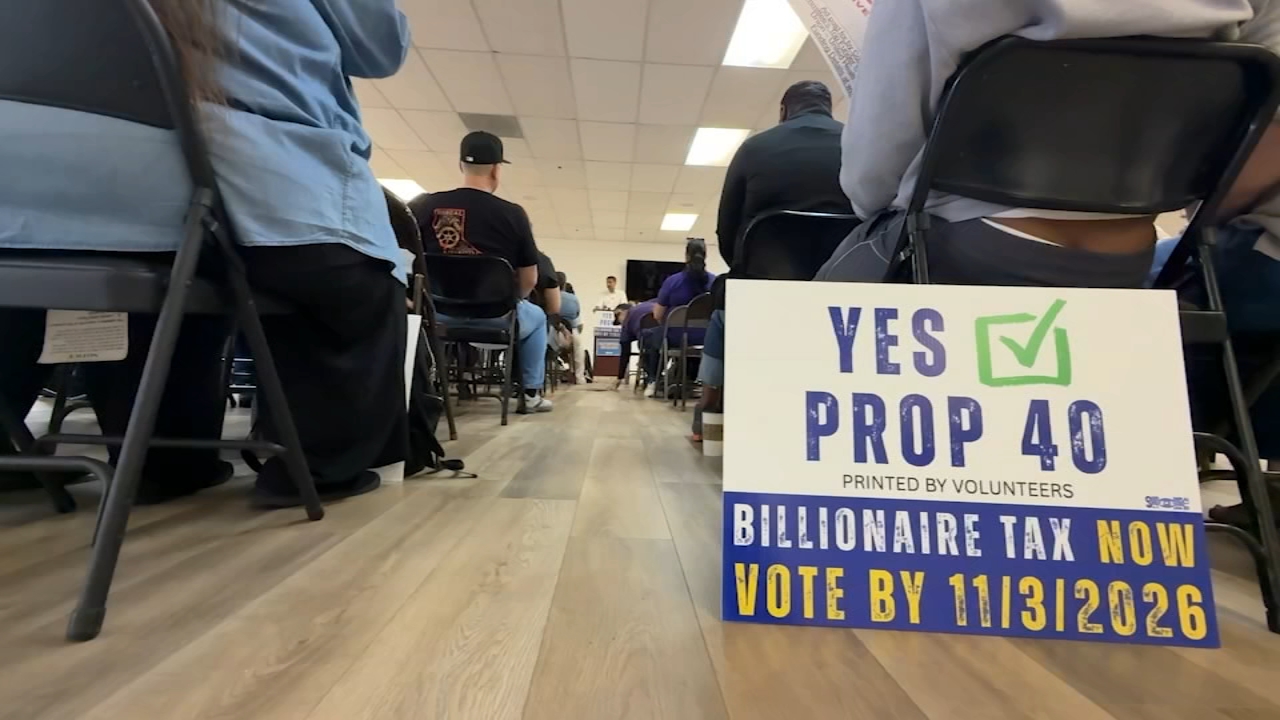
SAN FRANCISCO (KGO) -- For decades, organized labor has wielded significant influence in California politics. But in this election cycle, some of the state's most powerful unions find themselves on opposite sides of one of November's biggest ballot fights.
Proposition 40 would impose a one-time 5% tax on certain assets held by California residents worth more than $1 billion, with the bulk of the revenue going toward health care.
SEIU-United Healthcare Workers West is spearheading the measure, arguing the tax is necessary to offset major federal health care cuts. But the opposition includes groups that have often found themselves politically aligned with organized labor, including the California Teachers Association, California Professional Firefighters and the State Building and Construction Trades Council of California.
For Dave Regan, president of SEIU-UHW, describing the fight as a labor split misses the larger picture.
MORE: Despite Newsom's opposition, CA Democrats endorse billionaire tax measure
"First of all, I don't think labor is split. And again, we won the endorsement of the largest group of labor unions in California, which required a two-thirds supermajority," Regan told ABC7 Eyewitness News.
Regan pointed to the California Labor Federation's endorsement of Proposition 40 and argued some organizational leaders opposing the measure are out of step with their members.
"We're seeing just some kind of backroom, typical inside baseball, among political elites," Regan said.
A test of labor's political power
The fight is drawing particular attention because of the role unions have played in shaping California politics over several decades.
David McCuan, a political science professor at Sonoma State University, said labor's influence in Sacramento has grown as California has become increasingly Democratic.
"For the last 30 or 40 years, going out about another ten years or so, Labor's ability to push California politicians around to get what they want, not at the bargaining table, but really pushing in Sacramento, in the legislature, it's gone up and up," McCuan said.
But that political strength has never meant every union shares the same priorities.
He pointed to longstanding tensions between different corners of organized labor, including building trades, teachers and health care workers, whose interests can diverge, even when they broadly support many of the same Democratic candidates.
MORE: California voters will consider a measure in November to raise taxes on billionaires
"Labor is a huge, powerful block in Sacramento. And it's not really blue or red. It's just powerful," McCuan said.
Ballot measures can make those divisions particularly visible because, unlike negotiations in the Legislature, voters ultimately face a binary choice.
"Initiative politics always make for strange bedfellows," McCuan said.



Proposition 40 is proving the point. Its opponents include unions and Democratic-aligned organizations alongside wealthy Californians who could be subject to the tax, while SEIU-UHW has secured support from the California Labor Federation and California Democratic Party.
The disagreement also reflects a larger debate over how Democrats should respond to concerns about affordability, inequality and the concentration of wealth.
Some opponents have argued that they are not against higher taxes on billionaires in principle, but oppose this particular measure or believe the issue should be addressed federally.
Regan rejects the idea that California can afford to wait for Washington, arguing the federal health care cuts Proposition 40 is intended to offset will begin taking a greater toll next year.
"We are facing an actual collapse of our health care system," Regan said. "And the worst, the worst cuts are going to take effect come January 1st of 2027. Responsible elected officials need to tell people, what are we doing to deal with that?"
He argues the debate over extreme wealth and health care funding are intertwined.
"The billionaires, including California billionaires, have never had it better than they have it today," Regan said. "On top of that, we do have an honest to God pending health care catastrophe in California."
Opponents see significant risks in using a state wealth tax to address that problem. The No on 40 campaign has called the proposal "bad for our budget, bad for our economy, and bad for our future."
McCuan said the competing arguments put Proposition 40 in the middle of a broader ideological fight playing out within Democratic politics nationally, particularly over how aggressively the party should confront wealth and inequality.
"There's a little battle going on here within the Democratic Party. That's a kind of a proxy for the broader civil war that goes on nationally," McCuan said.
That tension is particularly notable in California, where prominent Democrats and labor organizations that frequently campaign on the same side are now preparing to spend the fall trying to persuade voters to opposite conclusions.
"Labor is not always whole. The environmental groups are not always all, 'and look, Democrats, that's a big tent,'" McCuan said.
With ballots beginning to go out Oct. 5, the campaigns may offer another measure of the political strength on each side: money. The pace of spending in the coming weeks could reveal how confident the campaigns are as Proposition 40 develops into what is expected to be an extraordinarily expensive ballot fight.
This November, the result will also provide a high-profile test of whether California labor's considerable political power holds when some of its biggest players aren't pulling in the same direction.