2026 MLB mock draft: Our expert makes every first-round pick

In our previous MLB mock drafts, we've focused on who teams are most likely to take with each pick -- mixing industry intel with what their draft history tells about preferences -- but now it's time for something a little different: a mock looking at who each team should take come July 11.
The idea here is to pick who I would pick if I were in charge based on how I rank this year's prospects, though because so many of these situations are coin flips between a small group of similar players, the tiebreaker goes to the kinds of players this team has taken in the past, who they've been able to develop/improve or who fits their current competitive situation (record, payroll, etc.).
For example, if a decision came down to a raw high school player or polished college player of similar value for a lower-payroll team that's a current contender, the team is going with the college player who likely arrives in the majors sooner.
I also am in the process of updating my rankings, so call this a soft launch of some bigger moves in those rankings. Here is who your team should be targeting at the top of this year's draft.

1. Chicago White Sox
Roch Cholowsky, SS, UCLA
This isn't as easy a call as you might think with a pretty clear top tier of Cholowsky, Grady Emerson and Vahn Lackey in this class.
With the White Sox contending right now and running a lower payroll, the lean is toward college players, so that gets us to Cholowsky and Lackey.
I don't think any of these players would cut a huge deal at this pick, and in general you should just pick the best player at the top pick. I'll go with Cholowsky because his combination of timetable, high floor, premium position and track record is just too much to pass up.

2. Tampa Bay Rays
Grady Emerson, SS, Fort Worth Christian HS (TX)
This one is fascinating, as the Rays also fit as a competitive, low-payroll team where the college options make the most sense. Lackey would go third if he doesn't go second, so there wouldn't be much of a deal here to make it a financial decision.
Because the Rays already have a deep big league team and farm system along with solid player development, they lean toward upside rather than just taking the player closest to the big leagues. Another close call, but Emerson fits best.

3. Minnesota Twins
Vahn Lackey, C, Georgia Tech
This is the easiest pick in the draft. Just take the player from the top tier who gets here and pay roughly slot value. The Twins are also a lower-payroll team that expects to compete in the next year or two when a premium college player would be showing up in the big leagues, so Lackey also fits well here.

4. San Francisco Giants
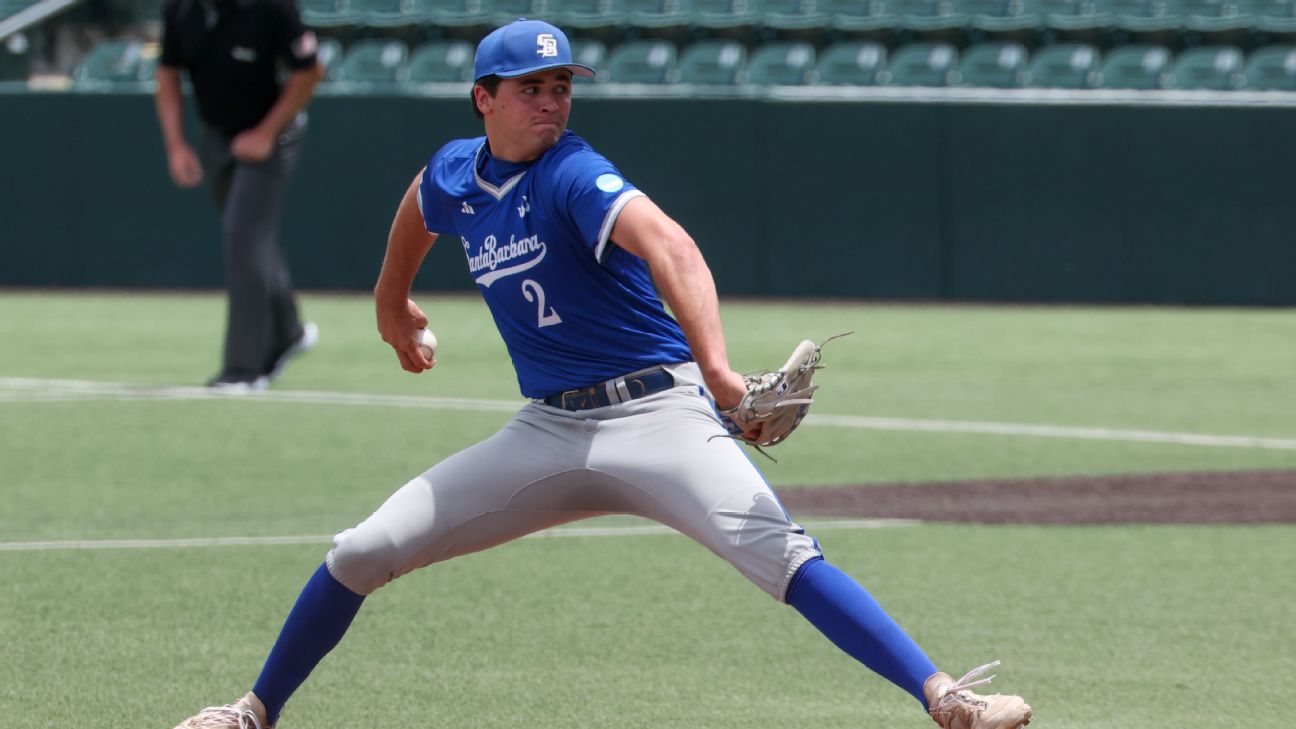
Jackson Flora, RHP, UC Santa Barbara
Now it starts getting tricky. You could go upside with riskier position players in Jacob Lombard, Justin Lebron or Eric Booth Jr., safety with Drew Burress, or the hot, rising name with Tyler Bell. Or, you could keep it simple and go with the consensus fourth-best prospect in Flora.
Flora shouldn't come quite as quickly or with the high floor of Cholowsky/Lackey, but he has front-line upside. For me, this is the last potential quick-moving college player with some ceiling where this line of thinking is relevant, so I probably would have gone with one of the upside choices if the Giants picked fifth and Flora was off the board.

5. Pittsburgh Pirates
Jacob Lombard, SS, Gulliver Prep HS (FL)
The Pirates are a lower-payroll team with playoff aspirations, but the college players available aren't talented enough to move them off the best talent.
In addition, I would only give Lombard to a team with a history of picking and developing players who will need a contact improvement and/or swing tweaks. Konnor Griffin is a nice recent example. Lombard's profile is similar to that of 2025 No. 4 overall pick Ethan Holliday at the same stage, but with even more athleticism/upside.

6. Kansas City Royals
Eric Booth Jr., CF, Oak Grove HS (MS)
The Royals can afford to wait and shoot for upside given their big league team, payroll and past draft tendencies. With everyone on the table and one player left in the consensus top six talents, Booth is the best option here. Right behind this pick, sorting through the similar options will become very difficult.

7. Baltimore Orioles
Drew Burress, CF, Georgia Tech
The Orioles take only position players at high picks and there are basically four collegiate hitters who fit as good options here: Tyler Bell, Justin Lebron, Burress and Ryder Helfrick.
Burress has the best combination of production, raw power, speed and defensive value, which is both a mix of what I'm looking for and what the Orioles seem to prefer.

8. Athletics
Tyler Bell, SS, Kentucky
I don't think a pitcher makes sense yet and I'd expect the rest of this college position player group to fly off the board first.
Bell is a switch-hitting shortstop with red-hot numbers down the stretch after a shoulder injury. He posted a nearly 1.100 OPS since mid-April with average raw power and plus in-game playability of the power.

9. Atlanta Braves
Ryder Helfrick, C, Arkansas
I think Atlanta would really like to get Drew Burress or Tyler Bell, so the top six talents might actually be more of a top eight now, from mixing together my opinion and that of those in the industry.
If things go chalk ahead of this pick, I could see the Braves taking a pitcher on a deal or Helfrick. Since I wouldn't get to spend the money I'm saving on this pick, I'll play it straight and go with Helfrick, a standout defender with plus raw power who hit 18 homers and drew 55 walks this season.

10. Colorado Rockies
Justin Lebron, SS, Alabama
Lebron is a polarizing player who is all over the place on draft boards. The Rockies need standout talent and can afford to be patient. I think scouts have gotten frustrated watching Lebron not make the leap this year and are overrating how bad his contact issues will be in pro ball; with a slightly flatter swing plane, I think there's a happy medium between contact and power.
We're almost into the "the next 20 players are all really similar" part of the draft.

11. Washington Nationals
Liam Peterson, RHP, Florida
The board is now wide open and lots of college pitchers are available. The Nats have been sneaky competitive this season and the new regime comes from Boston, where it was quite good at identifying pitchers it could optimize.
Peterson has the size, arm speed and spin rates that I think fit these specs. A little more fastball command and he could take off.

12. Los Angeles Angels
Cameron Flukey, RHP, Coastal Carolina
The Angels don't take high school players with their first pick and lean toward the quick-moving variety of college players.
I think Flukey offers the most upside of the best-available group at this juncture. His fringy breaking stuff plays well in college but his starter traits and fastball/changeup combo are also strong, with some parallels in style (not overall ability) to 2025 Angels first-round pick Tyler Bremner.

13. St. Louis Cardinals
Jared Grindlinger, RF/LHP, Huntington Beach HS (CA)
The Cards have had a solid run in their player development recently, helping them to rethink a bit what kinds of players they should draft to make the most of it.
Grindlinger possesses a premium set of traits as a pitcher and hitter: command of a three-pitch mix from the left side and elite bat to ball with a solid power/speed combination as a position player. Taking a two-way prospect here would give St. Louis parallel development projects that make Grindlinger a better option than the other top available talents.

14. Miami Marlins
Trevor Condon, CF, Etowah HS (GA)
The Marlins have been targeting players similar to the Orioles: position players with above-average power and some defensive/athletic value. There isn't a great option who fits that mold at this pick so I'd normally go with the best available college pitcher, but Condon is too good for me to pass up. He's a plus hitter and plus runner who has been super productive on the biggest stages. There's the faint rumble of Kevin McGonigle's music playing right now.

15. Arizona Diamondbacks
Derek Curiel, CF, LSU
The D-backs tend to lean to position players, specifically lefty-hitting hit-first types at up-the-middle positions, so I'll lean into that in this glut of similarly valued players.
Curiel can hit and play multiple outfield positions and has enough power but doesn't pull/lift enough; he has a high floor and medium upside.

16. Texas Rangers
Logan Reddemann, RHP, UCLA
There's some encouraging industry buzzabout Reddemann after he missed the end of UCLA's season with arm fatigue and I now think he'll go inside of the top 20 or 25 picks. He has the traits to become a solid No. 3 starter, and for teams that don't have a clear fit in a position player, he's a nice option who could move quickly.

17. Houston Astros
Daniel Jackson, C, Georgia
One of the biggest risers since my previous mock, Jackson appears to be the Golden Spikes favorite after winning the SEC triple crown as a catcher. He's an above-average runner and has the tools to stick behind the plate, so his polish as a catcher and contact rates are the only hesitations.
His profile combining raw power, measurable athleticism and defensive value also fits the Astros' tendencies. This pick is more of a high watermark for him, but I'd be surprised if he got past the 35th pick.

18. Cincinnati Reds
Cade Townsend, RHP, Mississippi
The Reds like power pitchers with strong breaking stuff, and Townsend has the traits to become a No. 2/No. 3 starter as he continues to improve. He's not that big and doesn't have a long track record of dominating the SEC but is a solid value here.

19. Cleveland Guardians
Chris Hacopian, 2B, Texas A&M
Hacopian probably goes higher than this, with some nibbles in the top 10 picks, but I'm taking the under for my purposes here. He is almost 22 years old and a below-average runner with medium physical tools and a flat swing plane.
Hacopian is very likely to be a big league infielder because of his bat-to-ball skills and wide base of skills, but some teams think he's trending the wrong way. I think he's a solid value here.

20. Boston Red Sox
Cole Carlon, LHP, Arizona State
I could see Carlon or one of the prep position players in my next few picks fitting here. Carlon survived a recent arm soreness scare and the upside is real: The 6-foot-5 lefty is up to 101 mph on his heater and has an almost 60% miss rate on his breaking pitches. That's at least a late-inning arm and maybe a front-line starter if it clicks; he could easily be a moderately surprising pick as high as 11th or 12th overall if his medicals offer teams no hesitations.

21. San Diego Padres
Gio Rojas, LHP, Stoneman Douglas HS (FL)
When in doubt for the Padres, give them a prep lefty. In this case, Rojas is the consensus top prep arm in the draft with some late top 10 interest but I prefer the college arms in this class with pretty similar upside but more track record while being only two years older. At this point in the draft, Rojas' upside makes sense for me.

22. Detroit Tigers
Tyler Spangler, SS, De La Salle HS (CA)
The Tigers love lefty-hitting high school infielders, and if Spangler's shoulder checks out, he's a solid value here. He had top 10 momentum entering the spring and didn't play much but has the traits a number of teams are looking for -- potentially as high as the middle of the first round in certain scenarios.

23. Chicago Cubs
Mason Edwards, LHP, USC
The Cubs could benefit from some quicker-moving talent if there isn't a compelling upside prospect available here. Several scouts have told me they see Edwards as perhaps the best quick-moving talent who could fit in a lot of roles early in his big league career but ultimately becomes a long-term starter.

24. Seattle Mariners
Bo Lowrance, 3B, Christ Church Episcopal HS (SC)
I've mentioned that Lowrance has a whiff of Freddie Freeman to him and I'm not the only evaluator coming to that conclusion about the lanky, lefty-hitting 6-5 prep prospect.
It could take a bit longer for him to move through the minors than it will for the college players in this area of the draft and he might move to a corner outfield spot, but the M's need to backfill their system as the top of it arrives in Seattle.

25. Milwaukee Brewers
Ace Reese, 3B, Mississippi State
Reese is still on the board because he could end up as a first baseman long term and his in-zone contact rate is a bit below average, but his in-game feel for power is elite. There are parallels in his profile to Andrew Fischer and Brock Wilken, college players the Brewers recently took with first-round picks, and I could argue Reese is the best draft prospect of those three; he should have lots of interest in the back half of the first round.
Teams that had first pick moved back as CBT penalty
Note: The Mets, Blue Jays, Yankees, Phillies and Dodgers all received a 10-pick penalty on their first pick for exceeding the second surcharge threshold of MLB's competitive balance tax.

27. New York Mets
Brody Bumila, LHP, Bishop Feehan HS (MA)
Bumila is 6-9 and has regularly been up to 100-plus mph from a lower slot with the multisport athleticism to project strike throwing. Whichever team takes him will have to teach him a usable breaking ball from scratch, but that kind of arm speed makes it easier than you'd think -- Seth Hernandez is a recent example of what you can do with premium arm speed, athleticism and coachability. Teams don't think he gets out of the 20s and the Mets are the kind of team that would take this gamble.

35. New York Yankees
Cole Prosek, 3B/C, Magnolia Heights HS (MS)
Prosek is an advanced hitter with 25-homer upside from the left side. He'll be 19 years old on draft day, a clear no-go for some teams but the Yankees aren't one of those teams. Defensively, he is a third baseman who has dabbled behind the plate, so there's a lot of upside even as an older prep prospect with limited physical projection.

36. Philadelphia Phillies
Will Brick, C, Christian Brothers HS (TN)
The Phillies love prep athletic-testing standouts at premium positions and Brick fits that profile while being young for the class after reclassifying from 2027. He's a catcher/shortstop tweener with 25-plus homer upside and feel to get to it in games.

39. Toronto Blue Jays
Archer Horn, SS, St. Ignatius Prep HS (CA)
A couple of scouts have told me their draft room thinks Horn is this year's Luke Dickerson, a prep prospect everyone likes who could get about $1 million more than many teams expected.
Horn fits the mold of players many teams like: lefty-hitting college shortstop with power potential and also some prospect status on the mound. Accounts differ on his bonus demands (he's a Stanford commit) and what scouts think his hit tool will be. A higher-payroll contending team like Toronto could be who takes the gamble high enough in the draft to meet Horn's price.

40. Los Angeles Dodgers
Taylor Rabe, RHP, Mississippi
Rabe is another late riser, with four distinct shapes that are average or better pitches, including a heater that has been up to 100 mph paired with a microscopic 4% walk rate. There's a lot to work with here for the 6-6 righty who threw only 16 innings in 2025 but was nails in the three postseason starts for Mississippi this spring, posting 18.2 IP, 12 H, 4 R, 24 K.
Related Topics
- SPORTS
- ESPN
- ATLANTA BRAVES
- MINNESOTA TWINS
- ARIZONA DIAMONDBACKS
- NEW YORK-YANKEES
- NEW YORK-METS
- PHILADELPHIA PHILLIES
- WASHINGTON NATIONALS
- SAN DIEGO-PADRES
- TEXAS RANGERS
- BOSTON RED-SOX
- CINCINNATI REDS
- TAMPA BAY-RAYS
- SAN FRANCISCO-GIANTS
- COLORADO ROCKIES
- LOS ANGELES-DODGERS
- DETROIT TIGERS
- MILWAUKEE BREWERS
- CLEVELAND GUARDIANS
- MLB
- CHICAGO WHITE-SOX
- KANSAS CITY-ROYALS
- ST LOUIS-CARDINALS
- HOUSTON ASTROS
- PITTSBURGH PIRATES
- TORONTO BLUE-JAYS
- ATHLETICS ATHLETICS
- SEATTLE MARINERS
- MIAMI MARLINS
- LOS ANGELES-ANGELS
- BALTIMORE ORIOLES
- CHICAGO CUBS