San Francisco turns to AI to avoid collisions between ships, whales searching for food

SAN FRANCISCO (KGO) -- More gray whales are entering San Francisco Bay, delighting spectators but increasing the risk of deadly encounters with ships, prompting scientists to deploy new AI technology aimed at protecting the animals.
San Francisco Bay was not historically a stopover during the gray whale's long migration, but it has become one over the past eight years.
Researchers say the whales are lingering in a specific area - a triangle between Angel Island, Alcatraz and Treasure Island - where they are feeding.
"There are whales that are feeding here, grey whales that are diving down and feeding on the sea floor mud and taking out the good stuff, shrimp and crabs and things like that, so that seems to be why they are aggregating here," said Doug McCauley of the Benioff Ocean Science Laboratory.
That same area is a major route for ships entering the bay, creating a dangerous overlap between marine life and vessel traffic.
MORE: Gray whale found dead near Alcatraz as CA expands program to slow down ships
"And these areas that they are foraging in are areas that are used as navigation water ways," said Kathi George of The Marine Mammal Center.
Last year, 36 gray whales were spotted in the bay, and researchers say they tend to linger for an average of 24 days.
In 2025, nine whales were found dead in the bay after being struck by ships, according to the Marine Mammal Center.
Scientists say the root of the problem begins in the Arctic, where gray whales typically feed.
"They feed on the sea floor and they feed on small invertebrates called amphipods, they are like shrimps and the amphipods grow by feeding on an algae that comes from sea ice that falls off sea ice," George said.
With less sea ice, there is less algae and fewer amphipods, reducing the whales' food supply and forcing them to seek nourishment elsewhere.
MORE: CA coast could soon be safer for whales with expansion of vessel speed reduction program
"Whales are hungry. They are not getting enough food in the arctic," George said.
As a result, the whales are making extended stops in places like San Francisco Bay to refuel during their 12,500-mile round trip migration to and from Baja California.
While visiting Angel Island, researchers observed whale skeletons on the beach, including one identified as an adult female gray whale following a necropsy.


"One of the whales, the middle skeleton, this was an adult female grey whale," George said.
To better monitor whale movements, scientists are using acoustic buoys equipped with underwater microphones to track whale sounds in real time.
MORE: 21 gray whales found dead in SF Bay so far in 2025, most since 2000: scientists
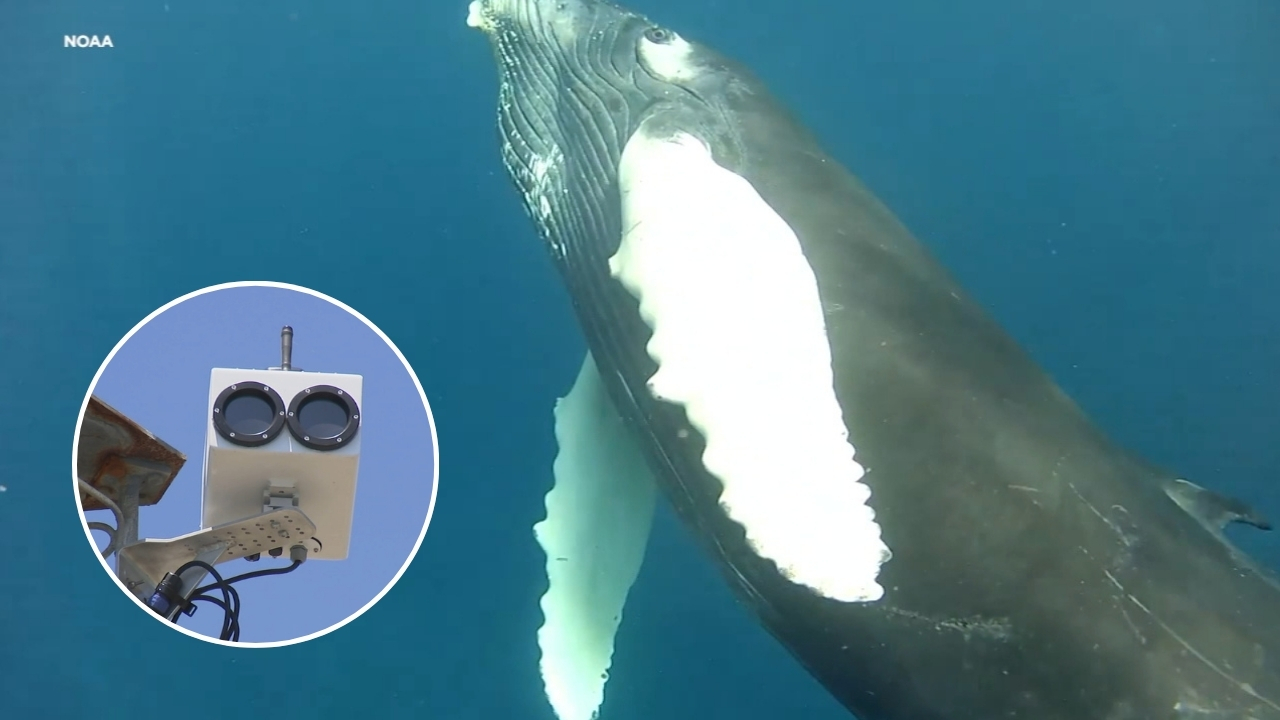
However, predicting their exact locations remains a challenge. A newly installed system called the Whale Spotter aims to address that. Located at Point Blunt on Angel Island, it uses thermal imaging to detect whales at long range by identifying the heat signature of their blows.
"We're particularly looking for the whale blow since we're using thermal imaging to detect the whales, that whale blow is a little warmer than the water in the air and it really stands out at really long range," said Shawn Henry of WhaleSpotter.
The system tracks whales and represents them as green dots on a screen, while nearby vessels appear as blue dots. It then sends real-time alerts to ships, giving operators time to change course and avoid collisions. The monitoring system works day and night, even in dense fog, and complements ongoing tracking efforts in the bay.
Researchers note that humpback whales are struck by ships less frequently because of their acrobatic behavior, which makes them easier to spot. Gray whales, by contrast, are harder to detect.
"They go bottom to top, so they can pop up suddenly. If you don't detect them very far out, you might miss them and if they pop up suddenly right in front of the vessel, that's where we have the real unfortunate case of vessel strikes," Henry said.
Officials say the WhaleSpotter is one of several tools intended to help gray whales and ships safely share the bay's waters as their paths increasingly intersect. This week, the San Francisco Ferry announced it has installed a WhaleSpotter on one of its vessels that will help alert the entire fleet.