Santa Rosa residents become 'Heat Heroes,' using science to help fight extreme summer temps

SANTA ROSA, Calif. (KGO) -- As temperatures rise across the North Bay this weekend, residents in one Santa Rosa neighborhood are taking matters into their own hands to better understand and combat extreme heat.
Community members in southwest Santa Rosa are participating in a new citizen-science initiative to track surface and air temperatures throughout the summer. Organizers say the information gathered will help shape a future "Extreme Heat Action Plan," designed to address long-standing heat disparities in the area.
For residents like Ben Rosel, the need for action is obvious.
"And I feel for our neighbors who don't have AC in their houses who deal with the heat every year," Rosel said. "It's getting hotter and hotter."
Rosel says Southwest Santa Rosa, particularly the Roseland area, lacks the shade and infrastructure that help keep other neighborhoods cooler during hot weather.
MORE: North Bay fire crews on alert as extreme heat raises fire danger
"Especially if you go down to Roseland, there's not a lot of trees on our sidewalks," he said. "Our sidewalks are very narrow, very hot and folks are tired of that."
Local nonprofits, Latino Service Providers and Greenbelt Alliance, have partnered with community members to launch the workshop series, which focuses on both climate resilience and environmental justice.
"We know that Southwest Santa Rosa experiences a lot of disparities when it comes to extreme heat compared to other parts of the city for different reasons, and we want to change that," said Stephanie Manieri of Latino Service Providers.
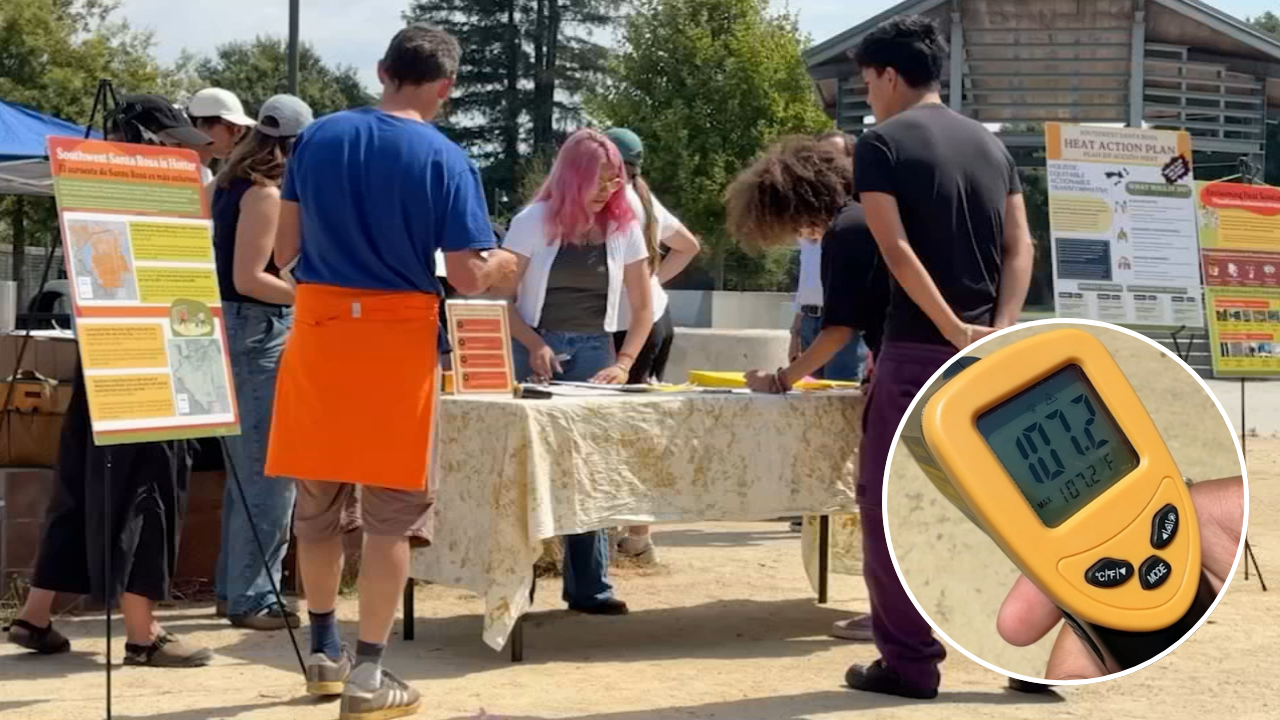
Participants are being trained as "Heat Heroes," learning how to collect temperature data using infrared thermometer guns and other monitoring devices.
During the workshops, residents measure the temperatures of sidewalks, dirt, pavement and other surfaces throughout their neighborhoods.
Some participants were surprised by what they found, recording ground temperatures exceeding 100 degrees. In addition to spot measurements, residents are receiving small temperature-recording sensors that will be placed in backyards for a month.


"Our goal is to get a whole month of data during both the day and nighttime, when you'd expect some relief from extreme heat," said Cesar Estien of Second Nature Ecology.
The information collected will become part of the Southwest Santa Rosa Holistic, Equitable, Actionable, Transformative Action Plan -- better known as HEAT.
Project leaders say the findings and recommendations will be presented to city leaders in 2027.
The plan is expected to identify ways the community can adapt to rising temperatures through solutions, such as expanded tree canopy, improved infrastructure and policy changes aimed at protecting vulnerable residents.
"So that we can actually see trees planted and see policy changed to make people safer," said Sadie Wilson of Greenbelt Alliance.
Rosel hopes the effort will ultimately bring more shade, cooler streets and greater climate equity to Southwest Santa Rosa.
"The change doesn't happen unless we organize and come together as a community to say we've had enough," he said.