Stanford lab using fungi to upcycle food waste
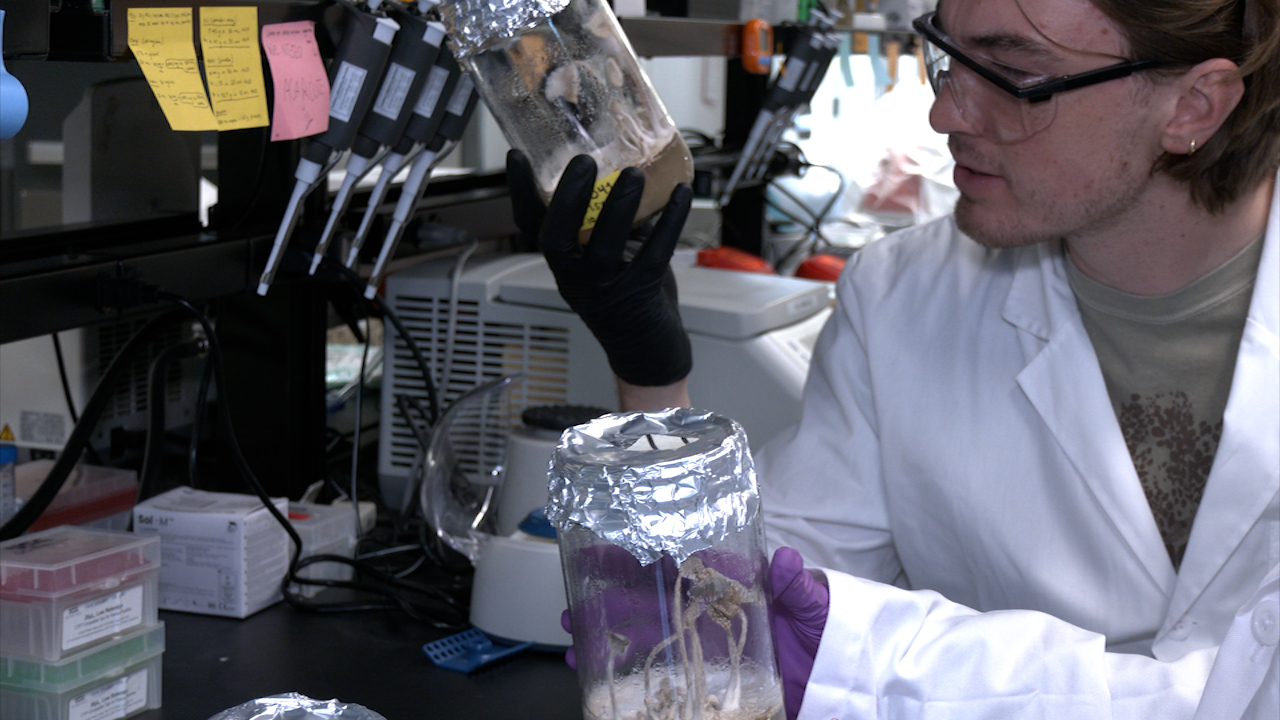

PALO ALTO, Calif. (KGO) -- Stanford researcher Vayu Hill-Maini, Ph.D., may be the rare scientist who loves being in the kitchen as much as the lab. Luckily, in his case, they're just a few feet apart. And linked together by the pursuit of a special ingredient that could someday help revolutionize our food system: fungi.
"So fungi are incredibly powerful and exciting. And although many people in this part of the world might think they're weird or poisonous or, you know, don't have a positive impression of that, but we're excited about this, what they can do for us, how can we harness their biological potential to solve sustainability challenges, he explains.
Vayu, started out life wanting to be a chef. He's now an assistant professor in the department of bioengineering. In his lab at the biosciences institute known as BIO-X, his team harnesses the kind of moldy fungi that form on food waste and naturally break it down. By combining sophisticated bioengineering techniques, including gene editing, they're able to control how the fungi behave and ultimately how it reacts chemically with the food in what's known as the fermentation process.
Just think of turning grapes into wine with yeast, also a fungus. But here, the goal of fermentation is to transform the flavor, texture, and even the appearance of leftover food waste. And repurpose it into a completely different edible dish.
"We don't just end with the science. We go into the kitchen and we actually develop and prototype products and ask people what they think. Is it, how does it taste? How does it smell? What do you feel? And that kind of goes informs us that in the lab of what we should discover and what we should engineer. So trying to create a kind of a loop between the lab and the kitchen," says Vayu.
Back in the kitchen, Vayu and Fellow researcher Alessandra Massa showed us some of their edible upcycling. Like soymilk waste from a local tofu producer turned into cheese.
"And so we're able to, through the fungal fermentation, transform this soy milk waste and use up to 70% as the final material and make kind of a Parmigiano-Reggiano-style hard cheese," he explains.


A few feet away, Alessandra Massa, PhD, head of the fungal food lab, sipped a new kind of sake drink, fermented from rice transformed by a specialized mold.
"And we found out the enzymes that is actually able to break down the structure of the rice. And then we ferment it, and we have an amazing beverage that has been served in the Mugaritz Restaurant, a two-Michelin-starred restaurant in San Sebastian, Spain, she adds.
And from exotic drinks to grilling up soybean waste burgers ... the Stanford team believes they can ultimately stretch the way we use food... while creating new flavors and recipes in the process.
"I mean, for me, it's having an impact at scale in the food system, right? So reducing waste, promoting food security and reducing emissions, making the food system less wasteful and more circular. If 30% of that doesn't reach the human body, you know, that's a waste of energy, that's a threat to food security. That's what would make me happy, says Vayu.
Potentially feeding a hungry planet with food that would otherwise go to waste. And to spice things up even further, the Stanford team recently introduced a program in partnership with the Doerr School of Sustainability to host a Chef in Residence. A Michelin-star chef to help develop flavors and new recipes.