Trump scales back US-South Korea drills, cites 'very good' ties with Kim Jong Un
U.S. ally South Korea has long faced threats from North Korea.

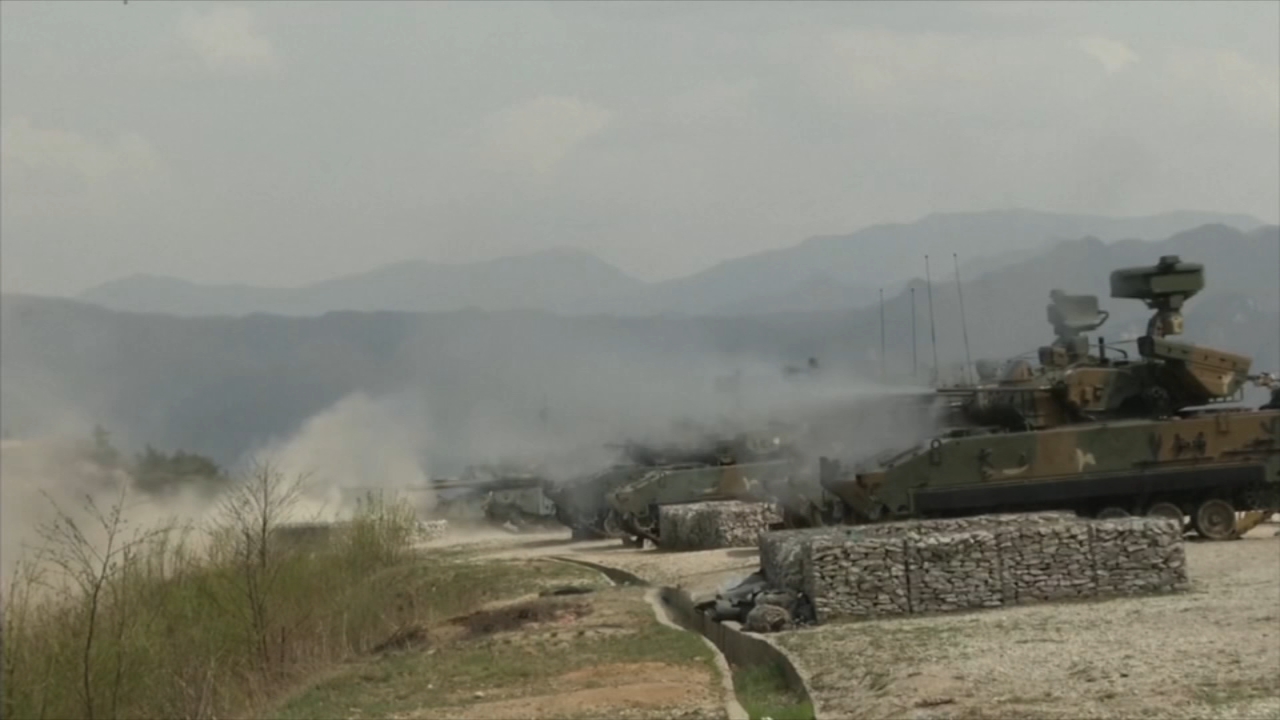
President Donald Trump announced Sunday that had directed Defense Secretary Pete Hegseth to "substantially reduce" joint U.S.-South Korean military exercises, citing his "very good" relationship with North Korea's Supreme Leader Kim Jong Un.
"Based on my very good relationship with Kim Jong Un, of North Korea, I am not happy with the fact that the United States has, long ago, agreed to participate in Joint Military Exercises with South Korea," Trump wrote on his social media platform.
"Therefore, and based on the fact that it is too late to cancel, I have instructed Secretary of War, Pete Hegseth, to substantially reduce the Joint Military Exercises!" he said.
Trump said the exercises send "inappropriate and hostile" signals to North Korea, a country he says has been "unthreatening and respectful" toward America during his presidency.
The annual U.S.-South Korea Ulchi Freedom Shield began on Monday. An official from the South Korean Ministry of Defense told ABC News that the military exercise now underway "will be carried on as planned."
South Korea is a longtime U.S. ally and hosts roughly 28,500 American troops. The U.S. presence on the peninsula has traditionally been intended to prevent a resumption of cross-border hostilities, with the Korean War of 1950-1953 having never officially ended.
In 2006, North Korea tested its first nuclear weapon and has since been expanding its atomic weapons stockpile -- despite international condemnation and sanctions led by successive U.S. administrations -- alongside a ballistic missile research program which has produced munitions capable of reaching the continental U.S.
In recent decades, the U.S. presence in South Korea has also become an important point of leverage in the strategic contest between Washington and Beijing, the latter having long served as Pyongyang's prime patron.
Trump's announcement came after North Korea on Friday threatened a strong response against the U.S. and South Korea in response to the planned drills.
In his post to social media, Trump also cited South Korea's refusal to join the U.S. military effort against -- and "denuclearization" of -- Iran, though said the issue was "somewhat unrelated (?)" to his decision to scale back the U.S.-South Korean drills.
In response to Trump's statement, South Korea's Ministry of Foreign Affairs told ABC News it hoped the "friendly relationship between the leaders of the United States and North Korea will lead to meaningful dialogue between Washington and Pyongyang and pave the way for discussions aimed at advancing peace and stability on the Korean Peninsula."



"The South Korean government has actively participated from the outset in international discussions aimed at securing a ceasefire in Iran and restoring freedom of navigation through the Strait of Hormuz," the ministry added.
Trump has long lauded his relationship with Kim, though the president's first term began with an extended period of tensions that saw Trump repeatedly refer to Kim as "little rocket man" and threaten Pyongyang with "fire and fury."
But the discord gave way to a detente that saw Trump and Kim meet in person three times in 2018 and 2019 -- first in Singapore, then in Vietnam and later in the Demilitarized Zone between North and South Korea.
But despite seemingly improved ties and the in-person meetings, Trump failed to achieve his stated goal of North Korean denuclearization.
Since talks with Trump broke down in 2019, Pyongyang has maintained a steady rhythm of ballistic missile tests. Earlier this month and with the U.S.-South Korea military drills approaching, North Korea conducted two ballistic missile launches in quick succession.
Recent years have also seen North Korea pull closer to both Russia and Iran, putting Pyongyang in opposition to the U.S. and its allies in the conflicts in Ukraine and the Middle East.
On Saturday, Russian President Vladimir Putin said that Moscow-Pyongyang ties have reached an "unprecedented level of comprehensive strategic partnership."
ABC News' Joohee Cho and Hakyung Kate Lee contributed to this report.