2026 NBA draft combine preview: Top prospects, events to watch
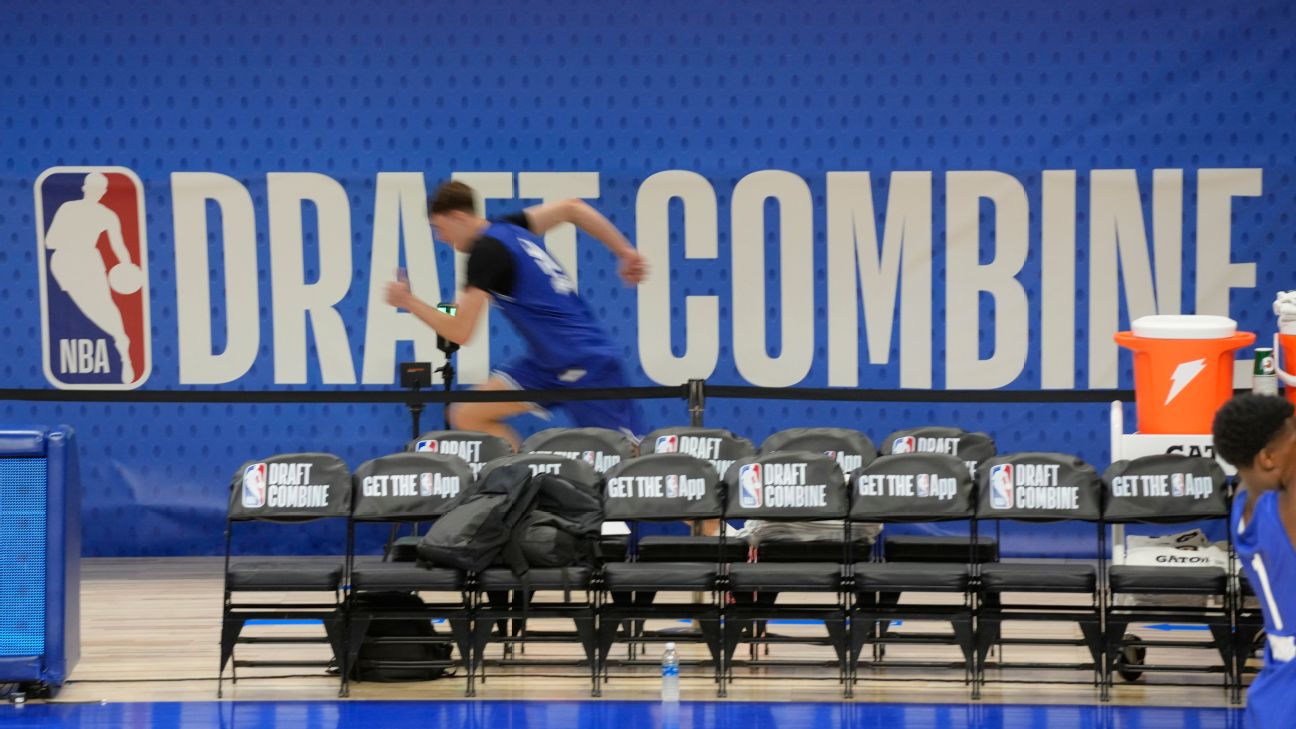

It's a big week for the future of the NBA: The 2026 predraft process officially begins Sunday as combine week gets underway in Chicago at Wintrust Arena.
Between the combine (beginning Monday) and G League combine (Saturday and Sunday), 117 players earned invitations, with all 30 NBA teams congregating to evaluate prospects and conduct business. Sunday's draft lottery (3 p.m. ET, ABC/ESPN) looms large over the week, with all eyes on likely top-five picksAJ Dybantsa(BYU), Darryn Peterson(Kansas), Cameron Boozer(Duke) and Caleb Wilson(North Carolina).
Prospects will go through a full slate of drills, measurements, athletic testing, medical examinations, team interviews and 5-on-5 scrimmages, giving them an opportunity to help themselves in varied settings. The combine is also where the offseason transaction wheel starts to turn, with teams and player agents all in one place.
ESPN will have full coverage from the combine all week. Here is a preview of what to watch for as action begins, including players, events and much more:
Jump to a topic:
Scrimmages matter| NIL impact
Peterson watch|How the PGs stack up
Under-the-radar prospects| G League combine

Why the scrimmages matter
The 5-on-5 scrimmages, which take place Wednesday and Thursday, remain the combine's signature event, and the primary opportunity for players to improve their standing and move up the board. The caveat is that they are optional, with top prospects perennially opting out of action. Every year, without fail, a few players help their stock by participating.
Last year, Yang Hansen and Yanic Konan Niederhauser were among the scrimmage standouts -- Hansen was drafted 16th overall, and Niederhauser (initially a G League combine invite) was picked 30th. Jalen Williams, Brandin Podziemski and Andrew Nembhard are among recent players who made a lasting impact by playing 5-on-5.
Despite the well-documented history of players helping their draft stock in scrimmages, agents are often protective, if not downright conservative, when it comes to having their players participate. In their defense, there can be a cooling effect if a player shows poorly. Under the current CBA, agents have less control over participation in now-mandatory elements of the predraft process and combine -- for example, the ability to withhold medicals from certain teams, or skip measurements -- but they can still opt out of 5-on-5 .
Still, NBA teams by and large respect players' decisions to compete -- and it's unlikely one day, whether positive or negative, will outweigh a player's complete body of work as teams continue their evaluations.
The impact of NIL
The NIL era has fundamentally altered the predraft process, with colleges now able to offer top players earning packages that can compete with, and in many cases well exceed, the slot value of a first-round pick on the NBA rookie contract scale. Firmly projected first-roundersThomas Haugh (Florida), Braylon Mullins (UConn) and Motiejus Krivas (Arizona) opted to return to school without testing. GuardJuke Harris(Wake Forest), viewed as a late first/early-second rounder, chose to withdraw from the draft last week and transferred to Tennessee without going through the process.
The change in financial incentives has also drastically reduced the number of international-based prospects exploring the draft, with the vast majority of those players now coming over to the U.S. to play D-I basketball, rather than pursuing draft-and-stash opportunities. Only four international-based prospects received combine invitations: Karim Lopez, Luigi Suigo, Sergio de Larrea and Jack Kayil (who is committed to play at Gonzaga next season), with the latter two not expected to be in Chicago.
The market forces continue to dictate the likelihood of a large second wave of draft withdrawals, with many notable college players testing and holding the option to return to school. The combine gives them an opportunity to gather feedback, as the NCAA's withdrawal deadline for college players is still a couple of weeks away (May 27, 11:59 p.m. ET).
Players currently ranked in ESPN's top 40 who NBA teams are awaiting full clarity on include Koa Peat (Arizona), Allen Graves (Santa Clara, transfer portal), Meleek Thomas (Arkansas), Ebuka Okorie (Stanford), Amari Allen (Alabama), Tyler Tanner (Vanderbilt) and Tounde Yessoufou (Baylor).
Other college players testing include Flory Bidunga (Kansas, committed to Louisville), Malachi Moreno (Kentucky), Billy Richmond III (Arkansas), Matt Able (NC State, committed to North Carolina), Andrej Stojakovic (Illinois), John Blackwell (Wisconsin, committed to Duke) and Jeremy Fears Jr. (Michigan State).
What will teams learn about Darryn Peterson?
There won't be many teams with the actual opportunity to select Peterson, ESPN's No. 2 prospect, on draft night. This combine will still be more important for him than for a typical top-tier player, however, let alone one who entered the year as my projected No. 1 pick. WhileAJ Dybantsahas overtaken him as the favorite to be the top pick, Peterson should still draw consideration from whichever team wins the lottery.
Lottery teams have done plenty of homework on Peterson, coming off an up-and-down season at Kansas. His freshman season was colored by a serious cramping issue that impacted him physically and mentally throughout the season, as well as a suboptimal on-court context, a combination of factors that put a damper on his projection. The combine is NBA teams' first opportunity to get to know him better in an interview setting and gain a more direct understanding of what happened. Peterson told ESPN's Ramona Shelburne this week that doctors attributed the cramping issue to creatine usage.
More importantly, teams in the top 15 will receive access to Peterson's medicals, giving them better insight into any lingering issues from the season. A clean bill of health would help solidify his candidacy at No. 2 and leave the door cracked for him to make his case at No. 1.
Two other notable players are facing similar questions about their health and incomplete seasons:Mikel Brown Jr.(Louisville), a projected top-10 pick, and Jayden Quaintance(Kentucky), who began the season viewed as a lottery candidate. What information comes out of that portion of the combine will have an effect on the shape of the draft, with Brown vying against several other talented freshmen for lottery position and Quaintance aiming to stabilize his draft range.
How will the point guards measure up?
Front offices continue to view this as a deep, impressive point guard class, with value at the position up and down the first round. The caveat is that a number of these guards are on the smaller side by NBA standards, a factor that often complicates projection, particularly on the defensive end. How these players physically stack up relative to one another might help create delineation within the different tiers at that position.


Darius Acuff Jr. (6-foot-3, Arkansas), Kingston Flemings (6-4, Houston), Christian Anderson (6-3, Texas Tech), Bennett Stirtz (6-4, Iowa),Ebuka Okorie (6-2, Stanford) and Tyler Tanner(6-0, Vanderbilt) are among the potential first-round options NBA teams are curious to obtain official measurements on. This information can be both positively and negatively significant when teams are splitting hairs as they finalize their board, with the sheer number of players fitting this broader mold making this an interesting subplot.
Under-the-radar prospects to watch

Tyler Tanner, Vanderbilt
No. 30 in ESPN's top 100
Tanner is coming off an outstanding sophomore season, as he emerged as one of college basketball's best guards and nearly lifted the Commodores to the Sweet 16. The caveat is he's one of the smallest players at the combine (listed at 6-0, 173 pounds) and is entering a deep draft at his position.
He has the option to return to Vanderbilt and be one of the faces of college basketball next season, but his exceptionally efficient campaign (48.5% FG) could be challenging to fully replicate. The combine scrimmages are a strong opportunity for him to make a statement and play his way firmly into the first round, something that could make staying in the draft more attractive.
Despite his stature, Tanner is an explosive athlete, active defender who makes the most of his tools, and a crafty scorer inside the paint who changes speeds well off the bounce. There's real intrigue around his skill set as a potential outlier-type player who could eventually excel as a spark plug off the bench.

Tarris Reed Jr., UConn
No. 36 in ESPN's top 100
Reed enters the draft with recent momentum, playing the best basketball of his career in the NCAA tournament and helping lead UConn to the national title game. Although he turns 23 in August, he's a rugged and dependable big man who could benefit as others withdraw from the draft.
While not a plus run-jump athlete, Reed is sturdy (6-11, 265 pounds), has solid touch around the basket, some playmaking ability at his size, and averaged two blocks and nearly a steal per game last season. With true centers presently back in style in the NBA, he should have an opportunity to play his way into the guaranteed-money mix with the rebounding and muscle he supplies. The combine environment is a good opportunity for Reed to showcase his motor and physicality against an array of other top college bigs as a potential plug-and-play pick later in the draft.

Peter Suder, Miami (Ohio)
No. 76 in ESPN's top 100
Suder was a surprise standout for evaluators at last month's Portsmouth Invitational, coming off a 32-2 season at Miami (Ohio), where he led the RedHawks in scoring and assists and was MAC Player of the Year. One of a handful of players who earned enough votes from teams to skip G League combine and land directly in the combine, Suder offers some sleeper intrigue and has played himself into the two-way contract conversation.
Suder turns 23 in August and has good positional size for a combo guard at 6-5. He was also quite efficient this season, shooting 54% from the field and 42.1% from 3 on nearly three attempts per game. He's a solid passer and can play on and off the ball with some role versatility as a blending player on the perimeter. Suder is not quick laterally, but he does compete defensively and has enough size to be physical. Despite lacking any one elite skill, he does enough things at an acceptable level to make his profile interesting.
It will be worth watching if Suder can keep up the positive showing in a combine setting against higher-level college guards. NBA teams have taken notice of the traits that could help him grow into a feasible depth option, but he'll have to keep proving it.
G League combine
The G League combine runs on Saturday and Sunday, putting 44 players through the same paces as the standard combine, with five to eight scrimmage standouts typically earning a promotion to the main event on Monday.
With the way that NIL has annually thinned the pool of draft-eligible prospects, G League combine carries even more significance and opportunity for its participants. Last year, six players were drafted out of this event, including Yanic Konan Niederhauser, who used it as a platform to advance to the combine and ultimately hear his name called 30th overall by the LA Clippers.
Selected in the second round were Brooks Barnhizer (Oklahoma City Thunder), Amari Williams (Boston Celtics), Lachlan Olbrich (Chicago Bulls), Will Richard (Golden State Warriors) and Jahmai Mashack (Memphis Grizzlies). Players like Ryan Nembhard (Dallas Mavericks) and Caleb Love (Portland Trail Blazers) wound up carving out real NBA roles as undrafted free agents.
Some names to watch at this year's combine include Bryce Hopkins (St. John's), Quadir Copeland (NC State), Tamin Lipsey (Iowa State), Jaron Pierre Jr. (SMU) and Malique Lewis (Southeast Melbourne, NBL).
]
Related Topics
- SPORTS
- ESPN
- OKLAHOMA CITY THUNDER
- GOLDEN STATE WARRIORS
- WILSON CALEB
- 2026 NBA LOTTERY
- WASHINGTON WIZARDS
- GRAVES ALLEN
- PEAT KOA
- FLEMINGS KINGSTON
- MEMPHIS GRIZZLIES
- NBA DRAFT
- CHICAGO BULLS
- PETERSON DARRYN
- MIAMI HEAT
- LOPEZ KARIM
- REED JR TARRIS
- TANNER TYLER
- DYBANTSA AJ
- ACUFF JR DARIUS
- DALLAS MAVERICKS
- 2026 NBA DRAFT
- SUDER PETER
- SACRAMENTO KINGS
- THOMAS MELEEK
- ANDERSON CHRISTIAN
- YESSOUFOU TOUNDE
- NBA
- MENS COLLEGE BASKETBALL
- BROOKLYN NETS
- STIRTZ BENNETT
- CHARLOTTE HORNETS
- UTAH JAZZ
- ALLEN AMARI
- 2026 NBA DRAFT COMBINE
- INDIANA PACERS
- MILWAUKEE BUCKS
- OKORIE EBUKA
- ATLANTA HAWKS