NHL trade grades: Report cards for biggest deals of 2026 offseason

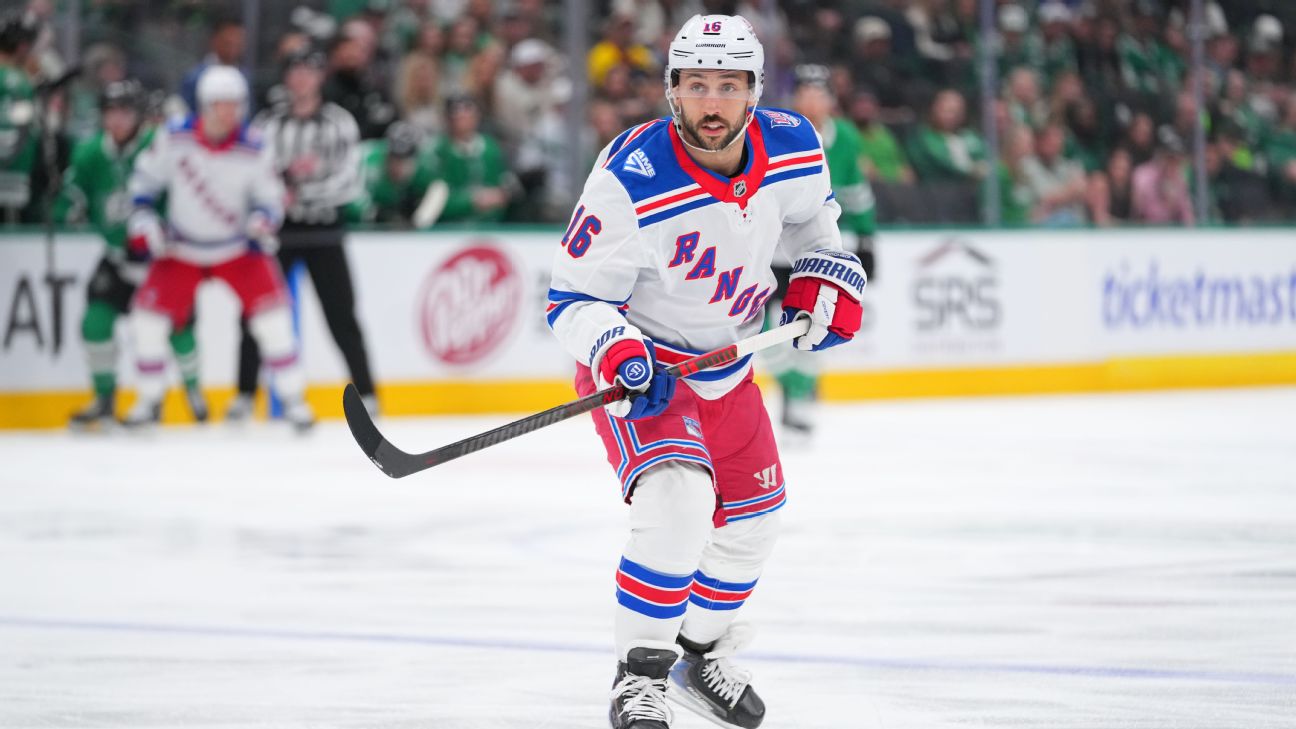
The 2026 NHL offseason trading period has begun.
As the deals continue to roll in, ESPN reporters will be grading all the moves with the biggest impacts, including instant reaction on how the GMs involved did.
The Toronto Maple Leafs and Tampa Bay Lightning kicked things into high gear, with the Leafs landing pending free agent defenseman Darren Raddysh on June 19. The Florida Panthers and Ottawa Senatorsthen turned the knobs up to 11 with a blockbuster trade that sent Brady Tkachuk to the Sunshine State, with four high draft picks heading back to Canada's capital.
On Tuesday, the New Jersey Devils traded 2022 No. 2 pick Simon Nemec to the Calgary Flames in exchange for future first-round picks. The Senators sent the No. 9 pick (part of the Tkachuk haul) to the San Jose Sharks for William Eklund, and the Washington Capitals dealt a package, including the No. 16 pick, to the St. Louis Blues for Jordan Kyrou. And if all of that wasn't enough, the Buffalo Sabres traded defenseman Bowen Byram and forward Jordan Greenway to the Chicago Blackhawks for the Nos. 4 and 45 picks and Louis Crevier.
The trades continued leading up to and during the draft, includingJJ Peterka, Pavel Dorofeyev and Mason McTavishfinding new homes. And on the eve of free agency, the Panthers landedJacob Markstromfrom the Devils.
Read on for more, and keep this page bookmarked as the trade volume rises ahead of free agency Wednesday.
Note: The most recent trades will appear highest up on the page.
Jump to a trade:
Bourque to NSH
Markstrom to FLA
McTavish to STL
Dorofeyev to NYR
Peterka to BOS
Nichushkin to CBJ
Tuch to WSH
Byram to CHI
Kyrou to WSH
Eklund to OTT
Nemec to CGY
Tkachuk to FLA
Raddysh to TOR

July 1: Rangers send Trocheck to Mammoth
The Utah Mammoth acquired forward Vincent Trocheck from the New York Rangers in exchange for defenseman Sean Durzi, forward Cole Beaudoin, and the earliest of Utah's 2027 third-round draft choices.

New York Rangers
Grade: B-
Sometimes there are movies that receive tremendous hype before hitting the theater, and upon seeing that film you're like, "That's it?" The same thing goes for NHL trades. For months, we heard about the Rangers' astronomical asking price for Trocheck, which scared off some teams at the trade deadline. The NY Post reported that "at minimum, [it's] a first-round pick, a roster player and a prospect." Sportsnet's Elliotte Friedman recently said that GM Chris Drury and the Rangers "still have a very high ask there, if not higher than at the deadline."
Hence, it's hard to review the movie we thought we would be seeing with the one we watched, so to speak. And that's probably not fair to the Rangers, who did pretty well here for a soon-to-be 33-year-old center who doesn't have a long-term role in their retool.
Durzi is a 27-year-old offensive defenseman who makes $6 million against the cap through 2028. He could play on their second pairing or eventually be a trade chip himself.
Beaudoin, 20, was the 24th pick in 2024 and put up 88 points in 54 games for the Barrie Colts last season. He's bigger than Trocheck (6-foot-2) but brings the same kind of motor and compete level, only 13 years younger. He's not Tij Iginla or Caleb Desnoyers, to name two of Utah's best forward prospects, but he projects to be a contributor on the NHL level.
Again, given all the hype around a Trocheck trade return, maybe a second-rounder would have looked better. But there's a chance that Leafs pick could be a high third, given their division.
Bottom line: The Rangers got a good prospect and a viable NHL defenseman for a player who no longer fit in their plans. Even if the return didn't deliver on the hype.

Utah Mammoth
Grade: A-
GM Bill Armstrong has been sitting on a treasure trove of picks and prospects since the NHL arrived in Salt Lake City two seasons ago. He kept his powder dry, waiting for the right opportunity and for his team to reach the point where a key veteran addition could be a difference-maker. After the Mammoth made the Stanley Cup playoffs, the time arrived.
Trocheck, 32, is an ideal pickup for a burgeoning contender, starting with his contract: Signed for three more seasons (through 2028-29) with a bargain level cap hit of $5.625 million. He brings 13 seasons of NHL experience and 56 games of playoff experience. He also played a key defensive role on Team USA's gold medal victory at the Milan Cortina Olympics in February.
That role playing is what sets Trocheck apart. He can be a defensive stopper, including on the penalty kill. He's a gifted offensive player at 5-on-5 and can work a power play. He's a center or a wing. He's a top-line player or someone doing grunt work down the lineup. Trocheck had 53 points in 67 games last season for a bad Rangers team, and his goal-scoring pace was slightly down from his past four seasons of 20-plus goals.
As former Rangers coach Peter Laviolette, now with the Kings, told me in 2024: "He touches every part of the game."
If there's a drawback here for Utah, it's that Trocheck is about to turn 33 years old next week and that he didn't bring any size to a lineup that could use more of it in the middle against the Western Conference's top teams -- although he does make up for his 5-11 frame with his tenacity.
The cost of acquisition here is fine for Utah, having avoided dealing away any of their tippy top prospects. They might miss Durzi's offense, but they have the defensive depth and prospect pipeline to withstand it.
Most of all, Trocheck's arrival is an endorsement of what the Smith Entertainment Group is building in Utah. He famously said he didn't want to head west as the Rangers sought to trade him over the past year. Now he'll call Salt Lake City home, as the Mammoth have built a team worthy of him taking this leap with his family. --Wyshynski
July 1: Nurse headed to San Jose
San Jose continued to be one of the league's most active teams of the offseason, acquiring defenseman Darnell Nurse from Edmonton on Wednesday in exchange for defensemen Shakir Mukhamadullin and the rights to Zack Sharp. The Oilers did not retain any of Nurse's salary in the transaction. (He has four years remaining on the deal with a $9.25 million AAV.)
The Sharks had previously added unrestricted free agent defenseman Jacob Trouba earlier on Wednesday -- the opener of NHL free agency -- and inkedMichael Kesselring(grabbed by Buffalo in a late-June trade) earlier this week to a three-year deal to bolster their blueline.
Now, Nurse comes on board to help there too. How did each side make out in the swap? Let's take a look.

San Jose Sharks
Grade: B-
There's plenty of debate over whether Nurse is overpaid. But that's not the Sharks' chief concern. Their issue was needing to add a top four defenseman to the group, and Nurse can potentially fit the bill. But the acquisition doesn't come without risk. Nurse is 31 and joining the Sharks at a pivotal moment in their youth movement. San Jose just missed out on making the playoffs last season, and while defensive breakdowns were part of what held them back, players in the back half of their careers (including Nurse and Trouba) might not be the long-term solutions San Jose is looking for.
As it is now, Nurse will get an opportunity to help anchor the Sharks' blueline by bringing some veteran experience. Nurse had played the entirety of his career in Edmonton as one of its go-to guys on the backend. He can be a big-bodied presence landing punishing hits, moving the puck and (at his best) reliably carrying heavy minutes at even strength and on the penalty kill. (He was the Oilers' leader in 5-on-5 ice time last season, along with Evan Bouchard.)
Still, it's a large contract for San Jose to take on, particularly given Nurse's struggles in the postseason. And with four years remaining, the contract could look bad down the road when the Sharks want to fully embrace their younger skaters. If Nurse can tide the team over until then, however, perhaps that will be victory enough.

Edmonton Oilers
Grade: B+
The Oilers invested heavily in Nurse, and while it took some time, the increased salary cap (and subsequently large paydays being handed out around the league) made the latter portion of Nurse's deal easier to stomach with a trade partner.
And Edmonton found the right fit with San Jose, which was willing to take him on full freight. That clean break is what the Oilers were hoping for once it became apparent Nurse's days with the club were numbered. Now, they can rework their blueline (or other positions) with ample cap space freed up by Nurse's departure.
The Oilers also will get a former first-round draft pick (20th by New Jersey in 2020) with Mukhamadullin entering the picture. The defenseman is 24 years old, and he had a solid season for the Sharks last season, producing five goals and 12 points in 50 games. There's room for him to grow and potentially be part of Edmonton's future success. Sharp -- a fourth-round choice by San Jose in 2025 -- had yet to make his NHL debut, and he is currently playing for Western Michigan. He is another player for the Oilers to have in their back pocket moving forward. -- Shilton
July 1: Stars send Bourque to Nashville for draft picks
Mavrik Bourque will remain in the Central Division as the Dallas Stars trade the forward to the Nashville Predators.
Bourque and defenseman Ilya Lyubushkin are going to Nashville for a 2027 second-round pick and a 2028 third-round pick (via VGK).
Here's a quick glance at what it means.

Nashville Predators
Grade: B+
Identifying a team's salary cap problems only to then take advantage of their situation is exactly what teams with cap space are trying to do at this time of the year.
Predators general manager Chris MacFarland did that with the Stars and all it took was parting with draft capital.
Both players the Predators got in this trade fit within what they were seeking this offseason. Bourque gives them another top-nine forward who could push for top-six minutes after scoring 20 goals and 41 points last season.
MacFarland got the Predators another young player who works as part of their future and can also help them now, much like Luke Evangelista and Matthew Wood.
PuckPedia projects that the Predators have $14.555 million in cap space to get a new deal done for Bourque after taking on Lyubushkin's $3.25 million cap hit.
Lyubushkin, who is in the final season of his contract, has a chance to be the most subtle part of this deal. The Predators churned through 12 defensemen last season. It's possible that he could help the Predators when it comes to their options on the back end should injuries or inconsistencies arise.

Dallas Stars
Grade: B-
It seems like there are two main takeaways from this deal when it comes to the Stars.
The first is that Stars GM Jim Nill didn't have the available cap space to sign Bourque, who was a restricted free agent. That meant he either needed to trade him and get something in return or risk losing him to an offer sheet, which could have left them in a more difficult position from a draft capital perspective by only likely netting a second-round pick.
Bourque along with Lyubushkin got Nill and the Stars two draft picks while allowing them to shed Lyubushkin's $3.25 million cap hit, giving them $12.514 million available in cap space.
And that leads to the second part, which is how they'll use that money.
One would expect that a large chunk of those funds will be used to re-sign RFA winger Jason Robertson. Getting a deal done for Robertson has been the most looming question for Dallas this offseason and one of the major topics going into the NHL offseason.
But that also comes with the caveat that making a potential deal for Robertson work meant the Stars had to lose a young, top-nine forward in the process. They'll really need to be smart about their cap space when it comes to adding more help up front. -- Clark
June 30: Panthers make deal with the Devils for Markstrom
Jacob Markstrom is back in the place where his career started, as the New Jersey Devils traded the goaltender to the Florida Panthers on Tuesday.
Markstrom and forward Angus Crookshank were traded to the Panthers, with forwards Jesper Boqvist, Evan Rodrigues and Ben Steeves going to the Devils.
Here's a look at what this trade means for all parties involved.

Florida Panthers
Grade: B+
Maybe Panthers GM Bill Zito saw the Colorado Avalanche reach the Western Conference finals with a pair of former Devils goalies and thought, "Why not us?"
All jokes aside, the trades Zito has made in less than 24 hours gives his team their new goalie tandem for next season and signals that the Sergei Bobrovsky era in South Florida is practically over.
Zito is retooling a roster that's seeking to win the Stanley Cup for the third time in four years after missing the playoffs in 2025-26. Goaltending was near the top of that list, given that Bobrovsky and Daniil Tarasov were both pending unrestricted free agents for a team that had to be smart about its salary cap space.
The Panthers have been getting business done early as they've executed six trades before free agency starts Wednesday. It's a haul in which they've acquired forwards Brady Tkachuk and Garnet Hathaway along with getting the rights to pending UFA defenseman Radko Gudas.
Their two most recent trades focused on their goalies, with the Panthers trading a 2028 third-round pick Monday evening to the Vegas Golden Knights to land Akira Schmid. Schmid is a pending restricted free agent; giving Zito a starting point. That bought him more time to evaluate the market and make the trade that is already a savvy move when it comes to the financials.
Markstrom is under contract for two more years at $6 million annually. The Panthers essentially added him for $1.42 million in actual cap space, with Boqvist and Rodrigues combining to have a $4.58 million cap hit. PuckPedia projects the Panthers now have $4.44 million in cap space leading into free agency opening Wednesday. That leaves room for them to sign Gudas and add around the edges elsewhere.
Of course, the major question now is whether the Markstrom-Schmid tandem will be good enough to win another Stanley Cup. Markstrom has struggled to find the consistency that he showed in 2021-22 when he was named a Vezina Trophy finalist; that season, he posted a 37-15-9 record, with a 2.22 goals-against average and a .922 save percentage.
While he's now riding a nine-season streak of 20 or more wins, he has a combined .895 save percentage in the past four campaigns.

New Jersey Devils
Grade: B
One of the reasons the Devils hired Sunny Mehta as their GM -- following his time as assistant GM under Zito with the Panthers -- was so he could make the necessary adjustments for them to challenge for a playoff spot. That included making a change with their goaltending tandem of Jake Allen and Markstrom if he believed it was the right move.
Markstrom's inconsistent performances with the Devils are well chronicled. But what made that inconsistency even more concerning was his $6 million AAV. New Jersey was a true tandem last season, with Markstrom playing 44 games while Allen played 37, the latter posting a .904 save percentage and a 2.74 GAA.
Following the trade, Mehta and the Devils still have $12.977 million in projected cap space in their search for a new goalie alongside Allen. Figuring out who they'll target is where it gets a bit complicated.
The goalies available via free agency all have question marks. Matt Murray had the highest save percentage at .922 but played in only five games. The next highest save percentage is Connor Ingram (.899), while the only two options with more than 20 wins last season are Stuart Skinner and Bobrovsky.
As a result, Mehta and his staff might look to explore another goaltending swap, focusing on:
- Teams that have a goalie who wants to be traded
- Teams for which moving on from a goalie would help them clear needed cap space
- Teams that believe they have a surplus in goal and could seek help in another part of their roster
Goaltending, while crucial, wasn't the only part of this trade. Rodrigues gives the Devils a proven middle-six winger who has five straight seasons of 10 or more goals and 30-plus points. He is a proven playoff winger who has one year remaining on his contract at a manageable cap hit.
In other words, he can either help the Devils should they make it to the postseason, or they could trade him to a contender ahead of the deadline.
Boqvist, who was a second-round pick by the Devils in 2017, could use a fresh start with his former club. He scored 10 goals and more than 20 points in each of his final two seasons in New Jersey. He finished with 12 goals and 23 points during his first season in South Florida, before those figures slipped to four goals and 13 points in 73 games in the 2025-26 season. -- Clark
June 26: Ducks send McTavish to St. Louis Blues
The St. Louis Blues acquire center Mason McTavish from the Anaheim Ducks for pick Nos. 15 and 29 in the 2026 NHL Draft.
Let's take a look at how both teams fared.

St. Louis Blues
Grade: C+
It's easy to understand why a lot of people believe in McTavish. He's only 23 and was selected third in the 2021 NHL draft. He has a heavy game to match a heavy shot. McTavish had a strong U18 worlds in 2021 and did well in the Swiss pro league that year. His competitiveness was his calling card during his draft year, when his overall game was earning some comparisons to Ducks center Ryan Getzlaf.
In some ways, McTavish delivered on that promise with the Ducks on offense, playing well at the net front and scoring 22 goals in 2024-25. In other ways, he has missed the mark. His skating, never his strong suit, has been exposed on the NHL level. His defensive play has been extremely substandard, ranking last analytically on the Ducks last season.
So, he's a project for the Blues. His defensive play should improve after being traded from Anaheim; Trevor Zegras was a defensive pariah with the Ducks before moving to the Flyers.
In a perfect world, McTavish actualizes as an NHL center to give the Blues a 1-2 punch with Robert Thomas, whom they're retaining after some trade rumors last season. McTavish's best chance at thriving in the NHL might be on the wing, where his defensive game and lack of speed are less glaring.
He's worth a gamble, although the price to acquire him was high because multiple teams were interested. On the plus side, he's locked in until 2031.

Anaheim Ducks
Grade: A-
Using the 15th pick, the Ducks selected right wing Nikita Klepov, the OHL's first rookie scoring champion since 1973-74. He projects to have top-line impact, even if there are some concerns about his defensive play. The Ducks might have found their version of Jake Guentzel.
Anaheim acquiring two first-round picks for McTavish was a nice move by general manager Pat Verbeek. The Ducks remove $7 million off their cap by trading a player who skated just 15:19 per game last season and was stuck behind a slew of talented forwards on the Ducks' depth chart. Anaheim has considerable cap space to address its blue line, which was hit hard by free agency, while preparing blockbuster extensions for centerLeo Carlssonand winger Cutter Gauthier. -- Wyshynski
June 26:Golden Knights deal Dorofeyev to Rangers
A tradition unlike any other: The intrigue of the Vegas Golden Knights' offseason.
The latest entry came Friday, when the Golden Knights traded winger Pavel Dorofeyev to the New York Rangersfor a 2026 first-round pick, a 2026 third-round pick and a 2028 first-round pick.
Let's take a glance at what this means for all parties involved.
New York Rangers
Grade: B+
One way of amplifying a rebuild is getting a 25-year-old winger who is coming off consecutive seasons of more than 35 goals for a team that just reached the Stanley Cup Finals.
The Rangers also got the top-line winger whom they and others coveted for a price that looks as if it could work out in the short and long term.
Having more than $25 million in cap space and draft capital meant that the Rangers had options in how they wanted to approach this offseason.
Those options included scanning every team's payroll to uncover vulnerabilities. Rangers general manager Chris Drury, similar to other executives, saw the salary cap struggles facing the Golden Knights and presented a package that was clearly too enticing to turn down.
Dorofeyev was a restricted free agent and is getting a seven-year contract at $11 million per season with the Rangers. The Golden Knights couldn't afford that contract, barring a trade that allowed them to shed additional salary elsewhere.
The Rangers didn't have to give up the No. 5 pick, which was used to draft defenseman Albert Smits.
The 2028 first-round pick is top-10 protected, which also buys the Rangers a bit of runway should they still be a lottery team by that point.
But there is a bit of risk here for the Rangers. Dorofeyev went from being in Vegas, where he was playing on one of the most talent-laden teams in the NHL, to a team that had the worst record in the Eastern Conference.
The Rangers will surround him with their best players. But it will be curious to see how Dorofeyev adapts to a new environment.

Vegas Golden Knights
Grade: B
The Golden Knights' salary cap situation remains the same, with PuckPedia projecting they have $4.625 million.
Vegas GM Kelly McCrimmon still has more work to do to get the roster to his liking. But to accomplish that, he needed to make a difficult decision somewhere.
Trading Dorofeyev could be the first of a few moves.
McCrimmon and the Golden Knights had team control. They could have drawn this out but why would they do that?
Dorofeyev would have commanded too high a price for McCrimmon and his front office staff, who have to contend with the following:
- Rasmus Andersson, whom they gave up quite a bit to get ahead of the trade deadline, is about to be an unrestricted free agent.
- Alex Pietrangelo, who missed this season and still has an unclear future as he recovers from a prolonged hip injury, is on the books at $8.8 million for the 2026-27 season.
- Adin Hill, who has five more years remaining at $6.25 million annually and didn't play in the playoffs, could help the Golden Knights clear cap space.
- Tomas Hertl, another player who could help their cap woes, has four more years remaining at $6.75 million annually.
The rest of the league can see those moving parts, which left McCrimmon needing to make a choice to alleviate cap money.
The Golden Knights' return for Dorofeyev didn't hurt their cap situation but provided them with draft capital that can help later. -- Clark
June 26: Bruins get Peterka from Mammoth
JJ Peterka is on his third team in 12 months after the Utah Mammoth moved the winger to the Boston Bruins on Friday.
The Bruins sent their 2026 first-round pick and a 2028 first-round pick (via FLA) that's top-10 protected to Utah.
Here's a quick breakdown of what it means.

Boston Bruins
Grade: B+
The Bruins are comfortable moving on from draft capital for the right price.
Given Peterka likely slots in as their first-line left winger next to Pavel Zacha and David Pastrnak, it's a price that appears to make sense because the Bruins were able to retain the Toronto Maple Leafs' first-round pick for next year.
So, to still get a top-six winger without having to give up that pick might be one of the most crucial pieces of this trade for the Bruins.
Boston was picking 23rd this year, and Florida, after extending its window following the Brady Tkachuk trade, could be expected to pick in that same range in 2028.
Peterka is a proven player who can help the Bruins now, and he's under contract for the next four years at $7.75 million annually.
The 24-year-old gives them a three-time 20-goal scorer. But the objective for the Bruins is seeing if Peterka can return to the player who averaged 0.88 points per game during his final season with the Buffalo Sabres rather than the iteration who averaged 0.57 points per game in his lone season in Utah.
Utah Mammoth
Grade: B
There are a few items that make this trade rather complicated.
Utah gave up Josh Doan and Michael Kesselringlast year to get Peterka. Doan had 25 goals and 52 points in his first season in Buffalo -- the same number of goals and five more points than Peterka's production with the Mammoth. Kesselring lasted only a season with the Sabres. They traded him to the San Jose Sharksin a deal that involved first-round picks being swapped.
The Mammoth thought Peterka could be part of their long-term core. But he struggled at times in Utah, which chose to move him.
Though it might be cold to move on one year after signing Peterka to such a large deal, it's also a bit calculated.
Shedding Peterka's salary means the Mammoth have $21.025 million in projected cap space, according to PuckPedia.
Having that much space while needing another top-six option on the wing allows the Mammoth to pursue players they might not have been able to when the day began. -- Clark
June 25: Avs send Nichushkin to Blue Jackets for picks
The pre-free agency trade market for wingers continued to churn on Thursday, when the Columbus Blue Jackets sealed a deal with the Colorado Avalanche for forward Valeri Nichushkin, with a 2026 second-round pick, 2027 third-round choice and 2028 fifth-round selection going back to the Avs.
How does this infusion of veteran talent for the Blue Jackets look compared to what they offered in return? Let's take a look.

Columbus Blue Jackets
Grade: B
The Blue Jackets needed to add to their depth scoring after a 19th-place finish offensively last season (averaging just three goals per game). Nichushkin was a viable option to help in that respect, and given the lack of undeniable top-six or top-nine skaters projected to be available in free agency on July 1, it made sense to part with future potential in return for a surer thing. And Nichushkin is that -- even with a $6.125 million annual cap hit over the final four years of his contract.
The 31-year-old has collected 20-plus goals in three of his past five seasons, and is a reliable performer in the postseason, particularly when Colorado won the Stanley Cup back in 2022. Nichushkin's numbers did take a dip last season, to 17 goals and 49 points in 72 games, but much of that can be attributed to the Avalanche's awful power play (sixth worst in the NHL at 17.1%). Nichushkin was strong at 5-on-5, and brings a physicality with his 6-4 frame that gives Columbus another element to its attack up front.
Mason Marchment and Boone Jenner -- two pending UFAs -- have provided some of that physicality in the past, but whether they'll remain in the Blue Jackets' mix is still unknown. The fact that GM Don Waddell went after Nichushkin suggests he isn't sure about bringing one or both of them back, either.
Finding a way to fit Nichushkin into the lineup did cost Columbus its only second-round choice in this upcoming draft. But if he can be a 20-goal scorer again for the Blue Jackets and fire up their power play like he has done before in Colorado, it'll be worth the investment.

Colorado Avalanche
Grade: B+
The advantage here for Colorado is shedding Nichushkin's contract to create cap space for other maneuvers. The Avalanche are still smarting from that Western Conference finals sweep by Vegas, and there are gaps to be filled in that will benefit Colorado in a larger sense than simply keeping Nichushkin.
The Avs didn't have a first- or second-round pick in the upcoming draft prior to dealing with Columbus, and now at least they can target a decent prospect -- or leverage that selection in another trade to improve right now. And it never hurts to have some draft chips squirrelled away to use in the future.
The success of this transaction primarily hinges on how the Avalanche make good use of that newly found cap room, and what further changes that will bring to a team that certainly doesn't feel its Cup contention window is anywhere close to closing just yet. --Shilton
June 24: Caps trade for Tuch, sign him for eight years
The Alex Tuch sweepstakes came to an early climax Wednesday when the Washington Capitals grabbed the winger in a sign-and-trade with the Buffalo Sabres that saw Tuch agree to an eight-year contract extension carrying an AAV of $10.5 million.
Meanwhile, Buffalo adds to its draft stores with a third-round pick in this weekend's draft, and the rights to UFA forwardDavid Kampf.
How did each side do in this one? Let's take a peek.

Washington Capitals
Grade: B-
Washington isn't fooling around. Less than 24 hours ago, the Caps acquired Jordan Kyrou from St. Louis to improve their top six, and now Tuch is coming on board to do the same. It's apparent the Capitals aren't letting last season's disappointment in missing the playoffs deter them from maintaining a win-now mentality. And this is quite an investment in Tuch -- and a significant raise from his last deal (carrying a $4.75 million AAV).
Tuch stands to be worth the price Washington is paying -- or at least the Caps hope he is. Because giving Tuch such a rich deal could easily backfire into an overpay situation if he can't live up to it.
But for right now, the 6-foot-4 skater brings size and speed to the Capitals' lineup, and he is coming off another impressive regular-season performance, having collected 33 goals and 66 points in 79 games to help guide Buffalo back to the playoffs for the first time since 2011.
The knock on Tuch there is that he didn't do much to help the Sabres advance once in the postseason. He notched just four goals and seven points in 13 games -- and had zero points in Buffalo's second-round series loss against Montreal.
But at his best, Tuch will improve a Capitals team that is still waiting to find out whetherAlex Ovechkin will be part of the mix come fall. The veteran is a pending unrestricted free agent who hasn't yet committed to another season. Perhaps the acquisition of talents like Kyrou and Tuch will persuade Ovechkin -- who turns 41 in September -- to come back for one more kick at the can.

Buffalo Sabres
Grade: A-
Buffalo fleeced Chicago in a trade Tuesday night, sending Bowen Byram to the Blackhawks primarily in exchange for the fourth overall pick in the 2026 draft.
Now, with the Tuch business handled, the Sabres have even more room to operate over the coming weeks as they keep retooling the roster. It was clear to both sides that Tuch wasn't going to be part of that. He and the Sabres had attempted negotiations on a new deal that were ultimately fruitless. Better to get something back for Tuch than see him walk away for nothing on July 1.
Buffalo didn't previously have a third-rounder in the coming draft, so it's one more piece to wield -- as a selection or as a trade chip -- over the next few days.
Kampf has been a solid fourth-line center option in the past and could be again for the Sabres if they can extend him. Should the Sabres get something done with Kampf before he hits free agency, it will give them a boost on the bottom end that's perhaps an upgrade, or at least insurance going into next season. --Shilton
June 23: Blackhawks add Byram for No. 4, 45 picks
The Chicago Blackhawks acquired defenseman Bowen Byram and forward Jordan Greenway from the Buffalo Sabres for the No. 4 pick and the No. 45 pick in the 2026 draft and defenseman Louis Crevier.
Here's how both GMs did in the swap.

Chicago Blackhawks
Grade: D
Let's start with the good news: Byram is the kind of dynamic offensive defenseman and general talent upgrade that GM Kyle Davidson needs to target. He had 42 points in 82 games last season, skating 22 minutes, 20 seconds per game and matching his career high with 11 goals. That would have easily made him the highest-scoring defenseman on the Blackhawks this past season. Crevier's 25 points led all Blackhawks defensemen ... and he's now a Sabre.
Byram's numbers should grow with more opportunity. Byram averaged only 1:36 per game on the power play for the Sabres, one reason why he had only one goal and seven helpers with the man advantage. The Blackhawks should hand him the keys to the top power play, along with top-pairing defenseman minutes.
He's still only 25 years old and has a ton of untapped potential offensively, especially if coach Jeff Blashill just lets him play with the puck as a de facto fourth forward out there. After six seasons, Chicago sort of knows what Byram is and what he could still become.
Which is to say that he's a known quantity -- which a draft pick is not. That's the only charitable justification for Chicago trading the No. 4 pick in the 2026 draft for Byram. They don't know how Chase Reid, (Sault Ste. Marie, OHL) or Alberts Smits (Jukurit, Liiga) or Carson Carels (Prince George, WHL) or Keaton Verhoeff (North Dakota, NCAA) will turn out to be as NHL players.
Connor Bedard is in his fourth season, never having come close to the playoffs. Davidson told The Athletic that he had "an extra bit of willingness or aggressiveness in trying to explore what's out there" this offseason. Waiting for another prospect to gestate could test Bedard's patience.
That said ... this is the No. 4 pick in the NHL draft. A recent study noted that 55.7% of the players drafted there play more than 500 NHL games.
Cale Makar was a No. 4 pick. So were Alex Pietrangelo, Sam Bennett, Mitch Marner, Brady Tkachuk and Lucas Raymond. The defenseman selected No. 4 in 2013 has played 912 games and won a Stanley Cup. His name is Seth Jones, and Davidson traded him to Florida for goalie Spencer Knight and a conditional first-round pick that was lottery-protected. And so the Panthers were able to use that pick to trade for Brady Tkachuk.
The No. 4 pick from 2019 has played 328 games so far. His name is Bowen Byram, and the Blackhawks just traded the No. 4 pick in this year's draft for the 2026 version of him.
Perhaps the most frustrating thing about this trade is that the Blackhawks are very much still in a rebuild. This is not the Utah Mammoth or the Anaheim Ducks, who both made the playoffs, or the San Jose Sharks, who were in the hunt until the final games of the season. This is a team that had the second-worst points percentage in the NHL last season (.439). The draft lottery gave them the No. 4 pick. And then they traded that pick to the Sabres. Astonishing.
Byram makes $6.25 million against the cap in 2026-27, and is an unrestricted free agent next summer. He'll sign an extension with Chicago, right? Right?
Greenway had one goal and five assists in 40 games last season for Buffalo, skating 12:27 per game. He's a fourth-liner with an expiring contract after next season.
Buffalo Sabres
Grade: A
It's startling to see Byram actually be traded after years of rumors about him moving. He wanted a bigger role as a No. 1 defenseman, knowing that Rasmus Dahlin and Mattias Samuelsson are locked in until 2029-30. As a pending UFA next summer, he could walk away to find that role somewhere else. The Sabres weren't keen on losing him, but the depth chart is the depth chart.
I know you're supposed to hold judgment on a trade involving draft picks until one has a sense of how the team receiving them ends up using them ... but Jarmo Kekalainen just got the No. 4 and No. 45 pick, and the Blackhawks' 25-year-old leading scorer on the blue line for Byram and a fourth-liner in Greenway.
Is he a hypnotist? Did Chicago think Buffalo was throwing Tage Thompson into the deal and it ended up being Greenway?
There has to be an explanation, because on its face, this the greatest fleecing in recent NHL history.
The Sabres can now use the No. 4 pick as the centerpiece in a trade for someone better than Byram. Or they could use the pick on someone who could eventually replace Byram on their blue line.
Crevier is a restricted free agent after next season, standing at 6-8 and breaking out with 25 points in 78 games last season.
In fairness, we can't go A-plus here because there's always the chance a subsequent blockbuster doesn't happen or that the No. 4 pick ends up being someone like Jesse Puljujarvi or Griffin Reinhart. But we can safely go "A" here for Kekalainen and the Sabres, if only for the fodder they gave to social media comedians on Tuesday night. --Wyshynski
June 23: Capitals add Kyrou, send pick No. 16 to Blues
The long-rumored trade of Jordan Kyrou finally materialized Tuesday when St. Louis sent the forward to Washington in exchange for pending RFA Connor McMichael, forward prospect Milton Gastrin and the 16th pick in the 2026 draft.
The Blues didn't retain any salary on Kyrou, who has five years remaining on his deal with an $8.125 million AAV. He also waived his no-trade clause to see the transaction go through.
Who came out on the winning end of this one? Let's take a look.
St. Louis Blues
Grade: B+
The Blues had been stagnant for too long. It was going to take a significant swing -- like, say, trading one of their top forwards -- in order to put St. Louis back on track. Consider the Kyrou deal an addition by subtraction.
There aren't many top-tier offensive talents available in free agency this summer, so it made sense for St. Louis to dangle this specific carrot to a team like Washington. It's no secret the Capitals were looking for an influx of scoring talent considering the murky future of Alex Ovechkin and their recent history of seeing a key player lost to injury -- like Pierre-Luc Dubois was for too much of last season -- and having it derail their offensive attack.
Washington paid a premium for Kyrou by sending Connor McMichael -- the 25-year-old center who is an RFA with arbitration rights -- along with a high draft choice. The pick is critical for St. Louis here because its prospect cupboard needs restocking, and now the Blues have four first-round choices in this upcoming draft. They can either make picks with each of them or swap those choices for other NHL-ready skaters.
If the Blues had to give up one of Kyrou or Robert Thomas, then this was likely the savvier move, too. Thomas has been hampered by injuries but still has a higher upside than Kyrou, whose numbers dwindled significantly last season (to 18 goals and 46 points in 72 games). This is a fresh start for both sides, and St. Louis made out well with the return and not having to retain any salary -- even if it might be worse on paper (right now) without Kyrou in the mix.
McMichael -- assuming a deal gets done -- will be a fine addition to the Blues' forward core and will inject some new life into the team as it attempts to turn the corner.
Washington Capitals
Grade: B
The Capitals have been searching for another top-six forward for over a year. They finally landed their man in Kyrou.
Is there some risk here on the Capitals' end? Yes. Kyrou hasn't thrived like the Blues expected when inking his eight-year, $65 million contract extension three years ago. And the fact that Kyrou is 28 and just finished the worst statistical season of his career since 2020-21 isn't ideal when this should be his time of peak performance. Kyrou's defensive game has been an issue, and too often he is only as good as the skaters around him.
However, there is no denying Kyrou's skill and that he can excel again (like he did in three consecutive 30-plus-goal seasons from 2022 to 2025) under the right circumstances.
Fortunately, the Capitals have some good linemates for him. Dubois, Tom Wilson, Dylan Strome, Aliaksei Protas and possibly Ovechkin could all be potential companions for Kyrou in some capacity, and it's nice for coach Spencer Carbery to have options in helping Kyrou return to form.
Washington had the draft capital to get its business done thanks to first-round choices at No. 16 and No. 18 in this weekend's prospect expo. Sending McMichael away had to be the toughest part. He has been an integral piece of the Capitals' success the past few seasons and was increasingly coming into his own despite a slight dip in production during the 2025-26 campaign.
Still, you can't get something for nothing, and Washington made the most of this season's lack of high-end free agent forwards with a tidy transaction. --Shilton
June 23: Senators flip No. 9 pick to Sharks for Eklund
Once the starting point for a rebuild with the Sharks, William Eklund has moved into another role for another team.
San Jose traded Eklund, prospect winger Kasper Halttunen and the rights to prospect forward Brandon Svoboda to Ottawa in exchange for the No. 9 pick in this year's draft.
Here's a look at what it means for everyone involved.

Ottawa Senators
Grade: B
The reason the Senators had the No. 9 pick as a bargaining chip to begin with stems from their substantial trade package in the deal that sent Brady Tkachuk to the Florida Panthers on Sunday. Part of the appeal of having that pick was that the Senators could use it in a trade package to land a player they felt was a replacement for Tkachuk.
Senators general manager Steve Staios did get someone who could help fill that void, with the primary question being: Was the No. 9 pick too high a price tag?
Finding a like-for-like replacement was always going to be a challenge for the Senators. There was talk that they could put together a package to make a run at Dallas Stars restricted free agent winger Jason Robertson. That speculation was met with a report from The Athletic that Robertson wasn't likely to sign a long-term contract in "a place like Ottawa."
Targeting Eklund allowed the Senators to get a young, two-way winger who can play top-six minutes and be used in other scenarios. He's under contract for the next three years at $5.6 million annually.
Eklund is a proven NHL player, though the Senators will need more offensive production from him. He has finished with 15 or more goals and 45 or more points in the past three seasons.
For his career, Eklund is averaging 0.65 points per game; Tkachuk has a 0.81 points-per-game career average.
It's possible that Eklund's production could see a surge by going to the Senators. And the Senators did add two more prospects in the deal, and both could help in the future.
If the Senators still feel they need more scoring help, they have $19.583 million in projected cap space (per PuckPedia) to address those needs, with free agency opening July 1.
San Jose Sharks
Grade: A+
If only there was another first-round, two-way Swedish winger whom the Sharks could draft on Friday. But we'll get to that shortly.
The Sharks have already collected quite a bit of talent during their rebuild, which likely made GM Mike Grier more comfortable dealing Eklund away. A rebuild that started with Eklund later added Macklin Celebrini, Will Smith, Yaroslav Askarov, Sam Dickinson, Michael Misa and Collin Graf, among others. That group led the Sharks to finish four points shy of the Los Angeles Kings for the final Western Conference wild-card spot this past season.
San Jose had more than $39 million in projected cap space available before the trade. So it's not like the Sharks necessarily needed the money. But adding the No. 9 pick when they already have No. 2 is the sort of scenario that can quickly boost the fortunes of a team trying to establish itself as a potential long-term power.
Grier and his staff can use the extra cap space to dip into free agency and possibly add more scoring help to replace what they lost in Eklund, with the idea that this will supplement what they do at the draft.
As for the draft, selecting Ivar Stenberg becomes a stronger possibility.
The 18-year-old winger finished with 11 goals and 33 points in 43 games while playing for Frolunda in the SHL, the premier Swedish professional league.
The Sharks could use the No. 2 pick on Stenberg, who projects as a top-line winger, and then select the best player available at No. 9. Adding those two talents to their young core would bolster one of the most promising young groups in the NHL -- one ready to take another big step forward in 2026-27. --Clark
June 23: Flames land Nemec from Devils for picks
Simon Nemec has a new home after the New Jersey Devils traded the defenseman to the Calgary Flames.
Nemec and forward Maxim Tsyplakov are going to the Flames in exchange for prospect defenseman Etienne Morin, a 2026 second-round pick (originally from the New York Rangers), a 2027 first-round pick (originally from the Vegas Golden Knights) and a 2028 first-round pick (originally from the Colorado Avalanche).
Here's a quick look at why it's a win-win move for the Devils and Flames.
New Jersey Devils
Grade: B+
Nemec wasn't going to work as a long-term option for the Devils for a few reasons. When a team drafts a defenseman like Nemec, who went No. 2 in 2022, there's an expectation he is going to be a top-pairing puck mover who also will quarterback the top power-play unit.
The issue is that the Devils already had Luke Hughes, drafted No. 4 in 2021. He is the same age as Nemec and has already signed his second NHL deal, making $9 million annually for the next six seasons.
Hughes, Dougie Hamilton and Brett Pesce averaged more ice time per game this season than Nemec, who was fourth. Jonas Siegenthaler averaged only 12 fewer seconds per game, and the Devils have other players they can use to round out their top six without eating into their cap space, which they would have had to do with restricted free agent Nemec.
In short, it was imperative for first-year Devils general manager Sonny Mehta to find a trade for Nemec that could help the Devils.
He did so in getting two first-round picks and a second-rounder as well.
Several factors contributed to the Devils missing the playoffs in 2025-26. Mehta and his staff will use this offseason to strengthen their roster to try to return in 2026-27.
The draft capital Mehta gained -- along with the Devils' $13.152 million in cap space, per PuckPedia -- gives him even more runway to address what he feels are the Devils' most pressing personnel concerns.

Calgary Flames
Grade: B+
Perhaps the most important aspect of any deal that Flames GM Craig Conroy makes is retaining his team's own first-round picks, given that the Flames are expected to be in a rebuild for the next few years.
But bartering with first-round picks that belong to playoff teams which are among annual favorites to win the Stanley Cup? Those are fair game to use in building a brighter future.
For a variety of reasons, Nemec could be a significant part of that build.
Conroy and his staff have used the past few drafts to build one of the strongest prospect pools in the NHL.
The proverbial jewel of their prospect pool is right-handed defenseman Zayne Parekh, who was selected ninth in 2024. Adding Nemec to the group gives the Flames a pair of defensemen drafted in the top 10 as a starting point for their blue line of the future.
This past season, Parekh had four goals and nine points in 37 games and averaged 17:08 in ice time, while Nemec had 11 goals and 26 points while averaging 19:40 in ice time in 68 games.
Adding Nemec three days before the NHL draft confirms that this might be one of the most important weeks for determining the Flames' future.
Calgary has the sixth pick and the 30th pick, the latter of which is one of the two first-rounders it got from the Golden Knights as part of the Rasmus Andersson trade in January. The Flames also have three second-round picks and two third-round selections.
Possessing that much draft capital -- while adding Nemec to a young core that already featured Matt Coronato, Matvei Gridin, Samuel Honzek, Dustin Wolf and Parekh -- only heightens the Flames' potential to emerge from their rebuild in the coming years. --Clark
June 21: Brady Tkachuk traded to the Panthers
Having Matthew Tkachuk simply wasn't enough for the Florida Panthers. That's why they collected the full set with the summer's first blockbuster.
The Panthers acquired Brady Tkachuk from the Ottawa Senators in exchange for the Nos. 9 and 25 picks in this year's draft, a 2029 first-round pick and a 2030 second-round pick.
So, what are the short- and long-term impacts -- aside from it being easier for their parents to catch all their games? Here's a look at how both teams performed in this trade and what it all means.
Florida Panthers
Grade: A
"There are levels to this." We hear that phrase a lot, and this trade is another example of why it's such a popular saying.
Of course, there's the Tkachuk of it all. It's been talked about for some time now. Especially as the NHL continues what must now be viewed as an exodus of star American-born players leaving Canadian markets. One of the earliest examples of that trend was, well, Matthew Tkachuk, back in 2022.
As for the dynamics of the trade itself? The first level came earlier Sunday, when Panthers general manager Bill Zito got the No. 25 pick in this year's draft in a trade with the Seattle Kraken in which Florida parted with forward Mackie Samoskevich.
By getting a second-first round pick in this week's draft, Zito had some options. It also meant the Panthers were saving potential cap space for something (or someone) else, with Samoskevich having yet to sign a contract as a restricted free agent.
But with all of that in his control, Zito offered a package that was headlined with the No. 9 pick and another first-round pick in this year's draft as part of a haul of three first-round picks, a tactic that showed his intent to get Brady Tkachuk and the need to win now.
Injuries to Aleksander Barkov and Matthew Tkachuk damaged the Panthers' bid for a third straight Stanley Cup this past season. But adding another Tkachuk to what should be a fully healthy roster makes what was already a dangerous team even more of a threat.
Panthers coach Paul Maurice will have a top-six forward group that can feature any combination of Barkov, Sam Bennett, Brad Marchand, Sam Reinhart, Carter Verhaeghe and both Tkachuk brothers.
That's seven forwards who are all under contract for at least the next two seasons. Brady Tkachuk has two years remaining on his contract worth $8.21 million annually, with the idea that there's a strong chance he'll likely re-sign with the club when the time comes. Matthew Tkachuk has four years left on his contract, at $9.50 million annually.
PuckPedia projects the Panthers still have a little more than $7.071 million in cap space now that they have both Tkachuks. It's still enough space to address what remains their biggest question going into free agency: goaltending.
Zito and his front office staff have between now and when free agency starts July 1 to figure out what their goaltending will look like, with the idea that their latest move to acquire the younger Tkachuk further reinforces why South Florida remains a destination.
Ottawa Senators
Grade: B+
The Senators were in what has become a familiar bind whenever a team has a star player who is constantly being discussed as a flight risk:
- Do you trade the player now with the aim of getting a significant return that can help you immediately and in the future?
- Or do you try to make it work, knowing there's a chance you could lose him for nothing in free agency?
Senators general manager Steve Staios took the first option and received a return for Brady Tkachuk that is indeed comparable to what his counterparts attained in similar deals involving Jack Eichel and Quinn Hughes.
That's the aspect of this trade that really can't be logically questioned.
Now, it's just a matter of what life looks like for the Senators post-Tkachuk. And that is the aspect of this deal that can be questioned, adding to the complexity in the aftermath.
The Senators now own three first-round picks in this year's draft -- and more than $25.183 million in projected cap space. They certainly can entertain nearly any option entering July 1.
Can the Sens use this coming week to get someone who is a like-for-like replacement for Tkachuk? Or do they pick up a player who is close enough when it comes to replacing Tkachuk's production?
Even the production aspect comes with a few questions. Is it important for them to go get another power forward who can consistently generate offensive opportunities? Or is it more about attaining the player with the strongest offensive skill set regardless of his playing profile?
Tkachuk averaged 0.81 points per game for his career with Ottawa. He averaged 0.98 points over 60 games this past season, and he scored 20 or more goals in all but one of his eight campaigns with the Sens.
Finding that player in free agency this summer could prove to be challenging. There are players available -- for now -- such Anthony Mantha, Mason Marchment and Alex Tuch who could be options if they do not re-sign or have their rights traded elsewhere prior to July 1.
There also will be teams that need to create cap space or players who could become options because they're in need of a change of scenery, includingJake DeBrusk.
What helps is that Staios and his front office can sell any potential options on what players would be coming to if they wanted to sign with the Sens.
Ottawa was a playoff team in 2025-26, and it is trying to get back to the postseason for a third straight campaign -- and advance beyond the first round for the first time since 2016-17.
They have a talented core led by Drake Batherson, Thomas Chabot, Dylan Cozens, Shane Pinto, Jake Sanderson, Tim Stutzle and Linus Ullmark.
It's a good sales pitch. But it comes with the understanding that there's going to be competition from other teams for those players, with the reality that it could take time (and possibly additional resources) to find the strongest replacement. -- Ryan S.Clark
June 19: Leafs land Raddysh from Lightning
The Maple Leafs acquired defenseman Darren Raddysh from the Lightning in exchange for Toronto's fifth-round selection in the 2026 NHL draft.
Raddysh has signed an eight-year contract extension with the Maple Leafs worth $8.5 million annually.

Toronto Maple Leafs
Grade: B
The NHL free agent puddle just got even shallower thanks to Toronto, as Raddysh was one of the best options for offensive defensemen. That said, there's undeniable risk for the Maple Leafs here. Raddysh, 30, had the best season of his late-blooming NHL career in 2025-26 for the Lightning: career highs in goals (22), assists (48), points (70) and plus-minus (+21), playing a career high 22:42 per contest in 73 games.
That a decent chunk of those points (26) came on a power play featuring NHL MVP Nikita Kucherov, Jake Guentzel, Brayden Point and others shouldn't be a strike against him. The defenseman with a booming shot will also have ample weaponry in Toronto, with Auston Matthews, William Nylander and potentially Gavin McKenna once the Maple Leafs draft him next week. Please note that Jim Hiller, just hired as Maple Leafs head coach, ran the power play during his four years as an assistant under Mike Babcock in Toronto.
Raddysh wasn't a one-dimensional player in Tampa. GM John Chayka of Toronto called him "one of the NHL's premier two-way defensemen, combining elite puck-moving ability with poise, competitiveness and strong play in all three zones." He's not wrong, based on the results last season.
Emphasis: last season.
Raddysh is one of two things. He could be a defenseman who figured things out a little later in his career -- keep in mind he was an undrafted free agent who got his start in the Chicago Blackhawks' organization in 2017-18 -- but then really hit his stride as a top offensive D-man. The Lightning have seen this story before: Dan Boyle was also an undrafted rookie who broke out at 26 but didn't hit his offensive apex until he was 30 years old (63 points).
Or, Darren Raddysh could be another in a long tradition of NHL players singing for the supper before unrestricted free agency. In his case, he belted out an aria.
The Leafs handed Raddysh an eight-year contract worth $8.5 million against the salary cap annually, which is a slight raise over the $836,000 in base salary he made last season. AFP Analytics expected his contract to net out to around $8 million annually on a six-year term. So the Leafs went a little higher and a little longer than you might want on a player like Raddysh, but given what the market could have been on July 1, they wanted to make sure they got him.
Logistically, he gives Chayka a new PP1 quarterback before the Leafs trade defenseman Morgan Rielly, assuming the seemingly inevitable comes to fruition.
Raddysh may never repeat last season's numbers, but they also shouldn't fall off a cliff. He's a good, solid addition to a Maple Leafs blue line that needed more puck-movers and defenseman that can win the neutral zone. It's a risk worth taking.

Tampa Bay Lightning
Grade: C+
The Lightning get a fifth-rounder for what amounts to the negotiating rights to Raddysh. Please recall they sent a third-rounder to the Carolina Hurricanes for the negotiating rights toJake Guentzelback in 2023.
They were hoping Raddysh might stick around on a hometown discount, with other lineup holes to fill and a monster extension for Kucherov looming -- he's entering the final year of his current deal. But with this kind of money on the table, Raddysh was going to walk.
Obviously, the gamble here by GM Julien BriseBois is that they're going to find another offensive defenseman who can fill the hole created by Raddysh for less money and fewer years than the Leafs handed him. That's not necessarily someone who can play PP1, assuming that Victor Hedman is good to go next season. But they could use another puck-mover on the right side, and don't really have anyone in their system that pops out as a potential replacement.
The search begins. -- GregWyshynski
]
Related Topics
- SPORTS
- ESPN
- CHICAGO BLACKHAWKS
- EDMONTON OILERS
- ST LOUIS-BLUES
- NEW YORK-RANGERS
- COLORADO AVALANCHE
- OTTAWA SENATORS
- BUFFALO SABRES
- NEW JERSEY-DEVILS
- COLUMBUS BLUE-JACKETS
- SAN JOSE-SHARKS
- FLORIDA PANTHERS
- TORONTO MAPLE-LEAFS
- UTAH MAMMOTH
- VEGAS GOLDEN-KNIGHTS
- WASHINGTON CAPITALS
- NHL
- TAMPA BAY-LIGHTNING
- NASHVILLE PREDATORS
- BOSTON BRUINS
- DALLAS STARS
- CALGARY FLAMES
- ANAHEIM DUCKS