California mail-in voting unchanged after Supreme Court blocks Trump restrictions


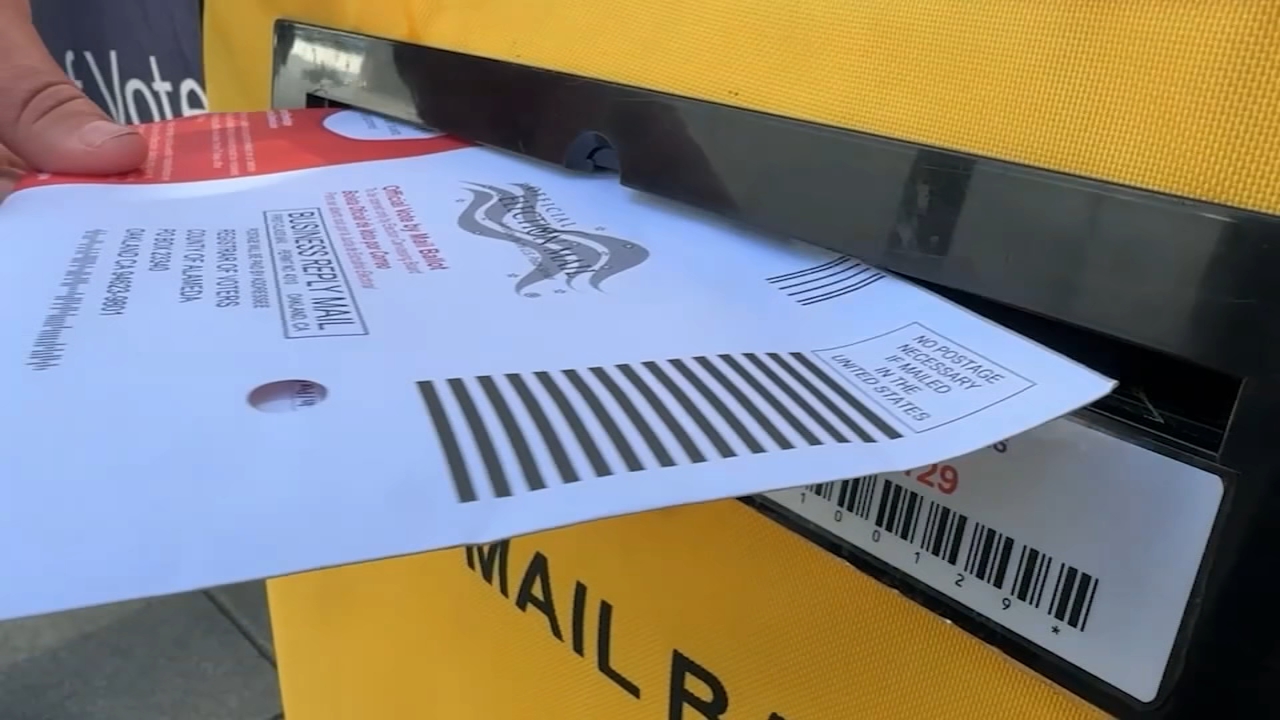
SAN FRANCISCO (KGO) -- The U.S. Supreme Court has rejected President Donald Trump's attempt to impose new restrictions on mail-in voting ahead of the November midterm elections, allowing California and other states to move forward with their existing election plans.
The brief ruling leaves in place a lower court decision blocking the U.S. Postal Service from implementing the changes. For California voters, the immediate takeaway is simple: The state's vote-by-mail system remains unchanged.
RELATED: Trump slams the Supreme Court for rejecting his push to restrict mail ballots
But the broader legal fight over who controls elections, and how much authority the federal government has over voting by mail, is not over.
In a lengthy social media post Tuesday morning, Trump accused the Supreme Court of letting the country down and repeated unfounded claims that mail voting makes voter fraud easier.
Attorney General Rob Bonta, who fought the changes, celebrated the ruling in a social media post, telling California voters that the midterms will be "business as usual."
"This is an important victory for the rule of law and our democracy," Bonta said.
Trump's executive order would have required states to provide voter registration lists to the federal government and imposed new requirements on mail ballot envelopes. The Postal Service would have also been allowed to reject mailed ballots in some instances.
The changes would have been especially significant in states such as California, where voting by mail is now the dominant way voters participate in elections.
Jake Grumbach, an associate professor of public policy at UC Berkeley, said the timing alone presented major logistical problems for states preparing for the midterms.
"This was going to be near impossible for states to implement. Some states, like Alabama and Wisconsin, have already started sending mail ballots," Grumbach said.
The Supreme Court found the federal "government is unlikely to succeed on the merits of its challenge," keeping the restrictions from taking effect as the election approaches.
Grumbach said the fight also raises a larger question about the division of power over American elections. States have traditionally administered elections, often delegating much of that work to local election officials.
"States have that constitutional authority and have and they delegate it to county election administrators," Grumbach said.
The ruling does not settle the underlying legal dispute for good. It addresses whether the restrictions can take effect now, meaning the fight over the federal government's authority could continue beyond the midterms.
The fight over mail voting goes beyond the courts
Even with the restrictions blocked for November, Grumbach said years of political battles over mail voting can create another problem: confusion and distrust about how votes are counted.
"By casting doubt on the process in general, what can happen is sort of an election informational meltdown," Grumbach said.
He said that can become particularly pronounced in California, where mail ballots can take longer to count and later results do not always resemble the votes reported earlier on election night. Grumbach said different batches of ballots can come from different neighborhoods and groups of voters, meaning the direction of a race can change as additional ballots are counted.
"That generates conspiratorial ideas that, oh, my candidate was in the lead and is no longer in the lead, when actually what we need to understand and every voter should think about in the U.S. is it takes a while to count ballots, and it's not over until the fat lady sings and all the ballots are counted," Grumbach said. "Do not go spreading sort of misinformation or taking early conclusions that may be off."
As election officials across the Bay Area marked National Voter Registration Day Tuesday, they stressed that voters should not expect the Supreme Court ruling to change how they cast their ballots this fall.
"The most important thing is to remind voters that everything is the same as before. There's been no changes based on this ruling. And now we continue to operate business as usual," said Julia Saenz with the Santa Clara County election division.
Saenz said one of the most important steps is also one of the simplest: properly complete and sign the ballot envelope before returning it.
California has used universal vote-by-mail since 2020, meaning every registered voter receives a ballot in the mail. Voters mailed in nearly nine out of every 10 ballots cast in California's June primary.
"It's a highly respected and secure form of running elections. And California's dramatically support this system," Grumbach said.
The Supreme Court's order provides certainty for the upcoming election, but it does not resolve the underlying legal questions surrounding the administration's push for greater federal involvement in elections.
For now, California's vote-by-mail system will operate as planned while the case continues through the courts.